Luigi Russolo, Carlo Carra, FT Marinetti, Umberto Boccioni, Gino Severini
FUTURISME
In France, Italian Futurism has often been the subject of interest condescending. Yet nothing can legitimately base this attitude: the intensity of plastic works, the magnitude and novelty of the theoretical expected, the major contribution to the growth of the movement of avant-garde appear indisputable.
In their perpetual desire innovation, the Futurists did not dream anything less than pleasing, using a resounding success in the resources of the provocation of the scandal, even violence. They made the singers intolerant of aggressive modernity symbolized by the machine and more abstract values related to movement and dynamism. No plastic arts was not their indifferent better, they questioned the limits and expanded their practice to writing, music, theater, decor.
The futuristic epic
Prehistory movement began in Rome in 1901, Umberto Boccioni and Gino Severini become students of the painter Giacomo Balla, who introduced him to sectarianism. In 1906, while Severini moved to Paris, Boccioni began a large European tour which ends next year in Milan. There will be forged soon other pictorial friendships: with Carlo Carrà and Luigi Russolo, Romolo Romani and Aroldo Bonzagni. That same year 1909 happens again the decisive encounter with Marinetti, the director of stirring Poesia, which Le Figaro published on February 22 preceding the founding manifesto.
Communication
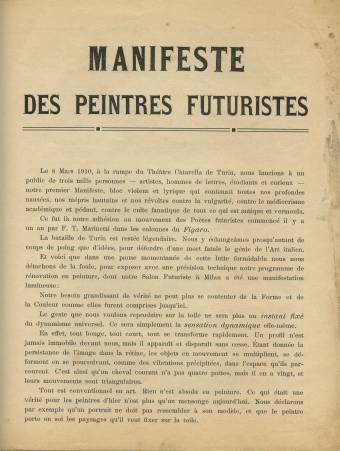
The February 11, 1910 appears as a leaflet published by Poesia proclamation: Agli artisti giovani d'Italia (known as Manifesto Futurist painters ). Marinettien in its aggressive form, the text is signed by the "Milanese" Boccioni, Carrà, Russulo and engaging the names of Balla and Severini. Following April 11, The Futurist Painting (Technical Manifesto said ) which specifies the thematic and aesthetic options of the group. Dozens of artistic events will follow until the end of the war on sculpture (Boccioni 1912 and 1913), architecture (Sant'Elia, 1914), photography (Bragaglia, 1911), film (Balla, Corra, Chiti, Ginna, Marinetti Settimelli, 1912), music (Pratella, 1911) and the bruitism (Russolo, 1913), dance (Valentine de Saint-Point, 1914) ... There is little themes of social, political and moral, literary, artistic or scientific, which are discussed in the futuristic perspective.
Futurists miss no opportunity to speak during the evenings in the Italian capital. They read texts and manifest delight in "the pleasure of being hissed" and exchange them "almost as many punches as ideas" (that of Boccioni, who "worked wonders" will be celebrated in a sculpture by Balla). They nevertheless possess the art of communicating and using plenty of the press can not ignore them, spread throughout Europe in interviews, statements and conferences. If Poesia , became in 1909 "Body of Futurism", disappears at the end of the year, the surviving editions widely disseminate leaflets and brochures. A little later, Lacerba - founded in Florence in 1913 by Giovanni Papini writer and painter Ardengo Soffici - Quickly became a place of expression and controversy for the movement, but also the support of experiences such as charts parolibere ("words in freedom").
Exhibitions
Exhibitions Group will meet its communication and advertising hype. If in 1911 in Milan are lacerating The risate Boccioni, hosting the international environment seems more favorable. Beginning in 1912 the Parisian gallery Bernheim-Jeune, the first major exhibition will tour the futuristic Europe and even cross the Atlantic to be presented Chicago. The preface to the catalog, Exhibitors the public, spreads and develops the theory futuristic it clearly marks the specificity, particularly in respect of cubism. In 1913, the group still participates in the exhibition organized by the avant-garde Der Sturm in Berlin.
War and the end of an adventure
The heterogeneity of the movement and its extension to new people (painters Enrico Prampolini, Fortunato Depero, Ottone Rosai and photographer Anton Giulio Bragaglia) exacerbate tensions. Sometimes capacity manoeuvrist Marinetti, sometimes authoritarianism succeed in reducing conflicts. But ultimately secession occur: in 1914, the poet Aldo Palazzeschi, then the following year, the text Futurism and Marinetti mark of the Florentine Lacerba and deprives the rest of the movement of its platform.
At this crucial moment, the futurists engaged in war propaganda and interventionist. "War, only hygiene of the world", they claimed a hue and cry, now provides the recurring theme. The ideological commitment not enough. Boccioni, Sant'Elia, Marinetti and Russolo, among others, enlisted: the first two were killed in 1916.
With the war finally turned a page is: Square is dedicated to the "metaphysical painting", the musical research Russolo, Severini, while moving towards classicism. Alone among the founders, Balla strives to develop (with his disciple Depero) principles of movement in a personal, non-figurative way. With leaders such as Gerardo Dottori, and Prampolini Fillia looming in the 1920s, the image of a 'second futurism', post-Dadaist. Once again, In 1929, Marinetti gather these energies for a new manifesto, The Futurist Aeropainting . But the revolutionary fervor of the opening movement is now broken and his tireless leader heavily involved in the compromise fascist.
The theoretical and technical
painterly manifestos of 1910 are prerequisites to practice plastic futuristic, even if they are based on principles more or less explicit in the earlier work signatory. They will lead to formal daring and unprecedented move to give the strong leadership which immediately imposes on the international stage.
The rejection of traditionalism
Like the prototype marinettien they relay some of the themes, these include the same overt loathing of the past while both men, institutions, models, pratiques.Les the futuristic slam professors "ignorant," archaeologists "necrophiliacs" critics "sold", painters "powerless" architects "businessmen" and not saving the public more, "unconscious rabble" who applauded. They denounce academies "gout," the atmosphere "could" museums - cemeteries promised to pick or fire - and the ignorance of officials. Denying outright the image referential artistic Italy, homeland of corpses, a huge whitewashed tombs of Pompeii ", they vilify the great historical centers, especially Venice, a city-fossil stigmatized in many obvious ( Kill the Moonlight and outdated Against Venice).
As for models, they suffer a real catastrophe. Paradigm of past art, the Mona Lisa , before becoming head of the massacre to Dada and Surrealism, receives a dubious honor: "flowers once a year at his feet." The dark paint to see convicted of counterfeiting. Only Rembrandt, Goya and Rodin, suspicious of bad taste, it even seems to find favor. But targets exist in modern times. The synthetic (without explicitly naming Gauguin), accused of "puerile and grotesque" Art Nouveau Secessionist rejected all the more violently it was investing once again the formal vocabulary and symbolic Boccioni and Carrà, the Independents, finally, "false budetliane" too, but that all should their favorite technique: divisionism.
The cult of speed
If the Manifesto of Futurism meant the machine as a symbol of modernity, it mythicize gear rapid transit trains, boats and especially automobiles. For their part, prefer to mention the obvious pictorial movement and the concept of speed. Immersed in this dimension man finds an agreement with the "universal dynamism", because "everything moves, everything short, everything changes quickly." From this, we can analyze two kinds of contiguous images. Each type of retinal due to the persistence images: "a galloping horse has not four legs, but twenty" (The Red Knight , Carrà, 1912). Other, more abstract experience related to Bergson's duration, incorporating fragmentary images recorded more or less deeply into the memory, they will play a key role in the evolutionary process of Futurism.
The theme
contrast to modern trends, the future does not relegate the subject to the background. Its essential link to the physical world as its social and political rehabilitate iconography. Some of the themes, present from the beginning, celebrate the urban world ( Suburb , Boccioni, 1909) and noctambulism ( Nocturne place Beccaria, Carrà, 1910), while others appear under the pressure of political events ( Flags in the altar of the fatherland, Balla, 1915) or warriors ( armored train, Severini, 1915). The apparent rise rapidly changing interests. The automobile gave birth in Balla and Boccioni to series, but nothing that seems conducive to the evocation of speed - train, cab, tram, horse, man himself - Is abandoned. The fury of the riots ( The Funeral of the Anarchist Galli , Carrà, 1911) or more prosaically clashes ( Brawl in the gallery, Boccioni, 1910) allows us to combine violence and movement. By equivalences plastics, futuristic transfer in the visible world as well the psychological (emotional , Boccioni, 1911) as the most diverse stimuli ( Music , Russolo, 1911). That disregard the woman was declared in no way prevents Boccioni to models mother and sister, nor to prefer Severini the dancers, only the "rotten ham fair" the naked remains prohibited. When the tendency to abstraction assert itself, especially in Balla, the subject will still be explained by the shock of the title.
futuristic image
sign of avant-garde in Europe, divisionism part as a condition sine qua non in the manifest as the complementarism. No doubt he is not able to order with the surface in the system of Seurat, but to accentuate the chromaticism incendiary pure colors and bring down the constructive rationality of the design.
However, this "complementarism congenital" can not be reduced to a choice of palette, so fundamental it is. The formula, revealing further condenses paradigmatic conception futuristic object that convenes in the surface all the elements that binds a relationship spatial-temporal or emotional. These links are embodied in lines-relational forces that encompass the viewer, moreover, "is now placed at the center of the table." This defines another complementarism object, simultaneously very different concept of Cubist namesake.
photography (and early film) concern Futurists from two points of view. It has its practitioner, Anton Giulio Bragaglia, inventor of photodynamic (The Slap, 1913). In addition, as technical annex, it provides for the representation of the movement's first comprehensive character of analog, derived from research chronophotographic EJ Marrey and E. Muybridge; girl running on the balcony (1912) Balla certainly realizes the prototype of the genre.
the example of the Cubists, the Futurists precipitate the end of the homogeneity of the painted surface. Experienced in the use of typography - the experience leaflets is for something - they include the words early in the image, first as being characteristic of the urban environment (North-South , Severini, 1912), then off to their semantic independently. The practice then merges with that of collages that emphasize the verbal message dominated by slogans, screams and onomatopoeia ( Event interventionist, Carrà, 1914). With the series Word in libertà Marinetti performing, in reverse, the path that connects writing and painting.
The "merry incendiary"
Group solidarity should not obscure the individualism and diversity of approaches, hence the discrepancies. Each jealously defending its discoveries plastics, especially with respect to the outside. Thus, in 1913, opened hostilities against Boccioni Cubism and his herald Guillaume Apollinaire diatribe with a vigorous anti-Orphic The Futurists plagiarized in France.
Umberto Boccioni (1882-1916)
Boccioni The central role in the genesis of the movement and its theoretical assumptions can be little doubt. It developed two basic concepts: the simultaneity as "synthesis of what we remember and what we see" and drive as "inner strength" of the object ( Exhibitors public ).
His plastic work is rooted in themes of symbolism inherited (La Signora Massimino , 1908) or inspired by urban and industrial society into this Self Portrait of 1908. Two key works, still linked to these concerns, marking its transition to futurism; The city rises (1910-1911) and the series of emotional (1911) incorporate this knowledge in new dynamism to the space destabilized by spatial interpenetration ( Ines, 1911). Then the practice of sculpture ( Head + house + light , 1911-1912) Boccioni back to a more nuclear subject is sensitive in the series of Dynamism 1913. This back and forth between the two engine orders completed plastic provides examples of the maturity of futurism as Unique Forms of Continuity in Space (1913) or spiral Construction (1914). Boccioni disappears rapidly in creative activity when his research give priority to a radical intensification of colorful reports ( Portrait Busoni, 1916).
Gino Severini (1883-1966)
Located in Montmartre, the City of Light Severini painted in a neo-impressionist airy and serene. It serves as a bridge between the Milan group and painters and writers of the Parisian avant-garde, including preparing the exhibition at Bernheim. From the beginning ( Dance of Pan Pan Monico, 1911), the way he absorbs strongly Cubism, it will remain fairly close by cutting Item Specifics - but rearranged dynamically - with the introduction of words in the image and the collage technique. Severini said its options in particular The Analogies plastic dynamism (1913-1914): a form given summons or other affinities simultaneous contrasts. Hence the equivalences expressed in the algebra of such securities Ballerina + sea = flowers (1913). The inclusions of materials (glitter, foil ...) contribute to the "intensification realistic" with parolibere and onomatopoeia and anticipating the experiences polymatière Prampolini, looming "end of the table and the statue" announced by Severini.
Carlo Carrà (1882-1966)
He returned to Carlo Carrà have painted works embodying one of the most completely original ideal of futurism. The Funeral of the Anarchist Galli (1911) refers unambiguously clear Marinetti who sang "the destructive gesture of anarchist" and the commitment of the painter. Very quickly, Carr's work reveals an original synthesis with cubist patterns ( Gallery in Milan , 1912) and techniques (collages of 1914). It develops the principles in a personal manifesto, Painting sounds, noises, smells (1913), which defines the concepts of equivalence and complementarism plastics. Others will follow theoretical texts published by Lacerba , they reveal his differences with Boccioni and his detachment of the mark "Marinette. By 1915, the interest of Carrà for large models of the past (from Giotto to Piero della Francesca) directs the search for "concrete forms" and Antigracieux (1916) prelude even before his meeting with De Chirico, in his passage to the metaphysical painting.
Luigi Russolo (1885-1947)
At the crossroads of multiple concerns of the group, Russolo's paintings are distinguished by the very organization set their surface. The saturated color, punctuated by great rhythms that dominate the primaries, clearly structured schemata borrowed from physical sciences and given as equivalent plastic dynamism ( Uprising, 1911). In 1913, Russolo published The Art noises. It advocates a radical revolution extending the arts to the diverse sounds of nature and machinery. Besides a new musical notation system he designed for his compositions networks sounds, unusual instruments, the intonarumori (glouglouteurs, scrubber, hooting, etc..). Russolo's intuitions are echoed in contemporary creation, in Varese, Satie, and especially in concrete music.
Giacomo Balla (1871-1958)
Away from Milan, Balla first gives a very strong version retinal futurism. It's time for funny Dynamism a dog leash and violinist's Hand (1912). But in 1913, the interpenetration iridescent orient their research in an abstract way, substituting the representation of speed to the movement. The plasticity of the form is growing in syntheses as Automotive + speed + light , reaching a kind of cosmic energy in The Transit of Mercury seen through a telescope (1914) suggests that the concerns of Robert Delaunay.
After the death of Boccioni, Balla becomes the central figure of plastic movement and sign the manifest with Depero Futurist Reconstruction of the universe. Besides the now abstract pictorial compositions ( Shape cry "Long live Italy" 1915) and its complexes incorporating different materials colored plastic, it is still interested in costume, décor and furniture.
Antonio Sant 'Elia (1888-1916)
Deriving from avant-garde group Nuove Tendenze Antonio Sant'Elia joined the movement in 1914 and published the Manifesto of Futurist architecture. Its architectural thinking has been expressed in projects designed for the Città Nuova, vision "Futures" of giant metropolis. The building blocks - buildings tiered, complex communication ground and air - are derived from the power plant, a symbol of Italian industrial and innovative. Nearby, Mario Chiattone (1891-1957) is not actually the group's projects use similar schemes which sometimes sounds echo formal Viennese secessionism.
Radiation futurism
Viscerally nationalist movement is not confined, however, not in Italy. Following his example, similar trends are appearing everywhere Worldwide: Formism or zonisme Polish vibrationism English Vorticism English strident Mexican ... Number of artists react more or less permanently: Delaunay, Duchamp and Picabia in France, August Macke and Franz Marc in Germany, Frank Kupka Czechoslovakia. It still affects Belgium and Central Europe, but also the United States, Latin America and even Japan.
Only Russian Futurism can be compared to its Italian counterpart. He possesses a tireless leader Vladimir Mayakovsky, published manifestos ( A slap in the taste Public , 1912) and counts leading artists such as David Burliuk (1882-1967), or the founders of Rayonism (1913), Natalia Goncharova (1883-1962) and Mikhail Larionov (1881-1964). From this trend, Vladimir Tatlin (1885-1953) and Casimir Malevich (1878-1935) in the expected to develop non-figuration of radical constructivism and supremacism.
So the futurism erected, not without tumult, the uncompromising modernism in dogma, managing to break the isolation of Italian art. Alongside of Cubism, his contemporary and rival, he can claim a role essential in the birth and spread of the avant-garde. For his radical rejection of any standard, he announced very directly Dadaism, and his transgression of limits, it is already conceptual art and behavioral.
Claude Frontisi. "Futurism", Encyclopaedia Universalis .
futuristic kitchen: