Georges Seurat. Bathers (Asnières). 1883-1884. 200 X 300. London, National Gallery
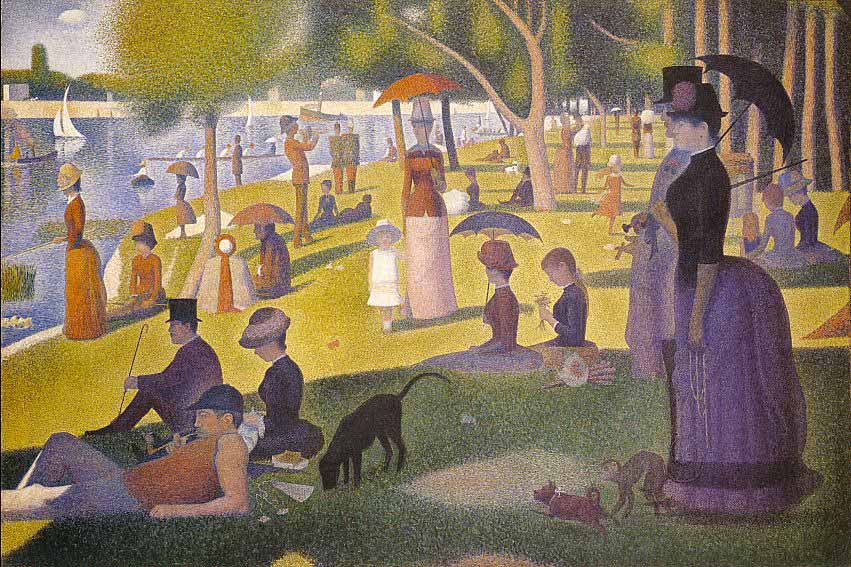 Georges Seurat. A Sunday Afternoon on the Grande Jatte. 1884-1886. 225 X 340. Chicago Art Institute of Chicago
A death. Born and died in Paris: December 2, 1859 to March 29, 1891. Four-year student at the Ecole des Beaux-Arts under Henri Lehmann. Beginning in 1883, the official Salon of the Palace of Industry: a pencil portrait, life size, his good friend John Aman, libretto by the comically titled Embroidery, exact title of another pencil, refused. At the barracks of the Rue des Tuileries, May 25, 1884, large canvas, Bathers (Asnières). At the eighth Impressionist exhibition, rue Laffitte No. 1, May 15, 1886, nine paintings or drawings, and finally sixty, exhibited the seven events of the Society of Independent Artists of December 10, 1884 to March 20, 1891. Of which: A Sunday at the Grande Jatte , Poseuses , Chahut , Circus, where fifty men and women walk, stretch, pose, dance, contemplate sitting, clapping, laugh, run, rush a horse, roam the area, extract sounds - calmly, in light yellow. (Painted in their actual size).
Wagnerian chromaticism
This was an ideal harmony. Art for him was the Harmony, and Harmony, the analogy of opposites, the analogy of similar - tone, hue, online. As an expression of this technique: the optical mixture of tones, hues and their reactions (shadows) following legislation substantially fixed. And Georges Seurat was the real initiator of the division of tone, it must be said again. At its last exhibition new innovation, he had substituted for the white box or neutral part painted in shades of contrast, color and pattern lines.
As Maximilien Robespierre, Georges Seurat believed in what he said (rarely), so that it performed. It was silent, obstinate and pure. Just as he gave the people a hieratic austerity, he attributed to the nature of ecstasy Lull, calm and so he painted landscapes of BasseNormandie, Picardy, Seine.
A sudden stupid sickness prevailed in a few hours, amid the triumph (...)
Jules Christophe. "Chromo-Luminar: Georges Seurat." La Plume , 1 September 1891
 Georges Seurat. Poseuses. 200 X 251. 1886-1888. Merion, Barnes Foundation
Georges Seurat took courses at the School of Fine Arts, but his intelligence, his will, his methodical mind and clear, taste so pure and his painter's eye kept him from the influence depressing the School. Frequent visitor to museums, browsing in the library of art books and prints, he drew from the study of classical masters strength to resist the teaching of teachers. In these studies, he found that they are, similar laws governing the line, chiaroscuro, color, composition, as in Rubens than Raphael, Michelangelo as in Delacroix: rhythm, measurement and contraste.La Eastern tradition, the writings of Chevreul, Charles Blanc, Humbert de Superville, of ON Rood, H. Helmholtz renseignèrent. He analyzed at length the work of Delacroix, it easily found the application of traditional laws, both in color than in line, and saw clearly what needed to be done to make the progress that the teacher had glimpsed romantic.
The results of studies of Seurat was his wise and fruitful theory of contrast, which he submitted when all his works. He first applied in chiaroscuro: with simple resources, the white sheet of Ingres paper and black Conté crayon, carefully shaded or mixed, he executed some four hundred drawings, the most beautiful drawings by painter available. With perfect knowledge of values, one can say that these white and black are brighter and more colorful than many paintings. Then, having thus made himself master of the contrast in tone, he treated the hue in the same spirit and, in 1882, he applied to color contrast and the laws of painting with separate elements - using shades folded, it is true - without being influenced by the Impressionists, at the time, he did not even know existed.
[...] In 1884, the first group exhibition of Independent Artists in the barracks of the Tuileries, Seurat and Signac, who did not know, met, risked his Seurat Bathing , refused the Salon of that year. This picture was painted in large flat keys, swept over each other and, from a palette composed such as Delacroix, pure color and earthy colors. Of these lands and ochres, the picture was dull and seemed less polished than what the Impressionists were painting with their limited palette colors of the rainbow. But compliance with the laws of contrasle, methodical separation of the elements - light, shadow, color local reactions - their right proportion and balance in this painting conféraientt perfect harmony.
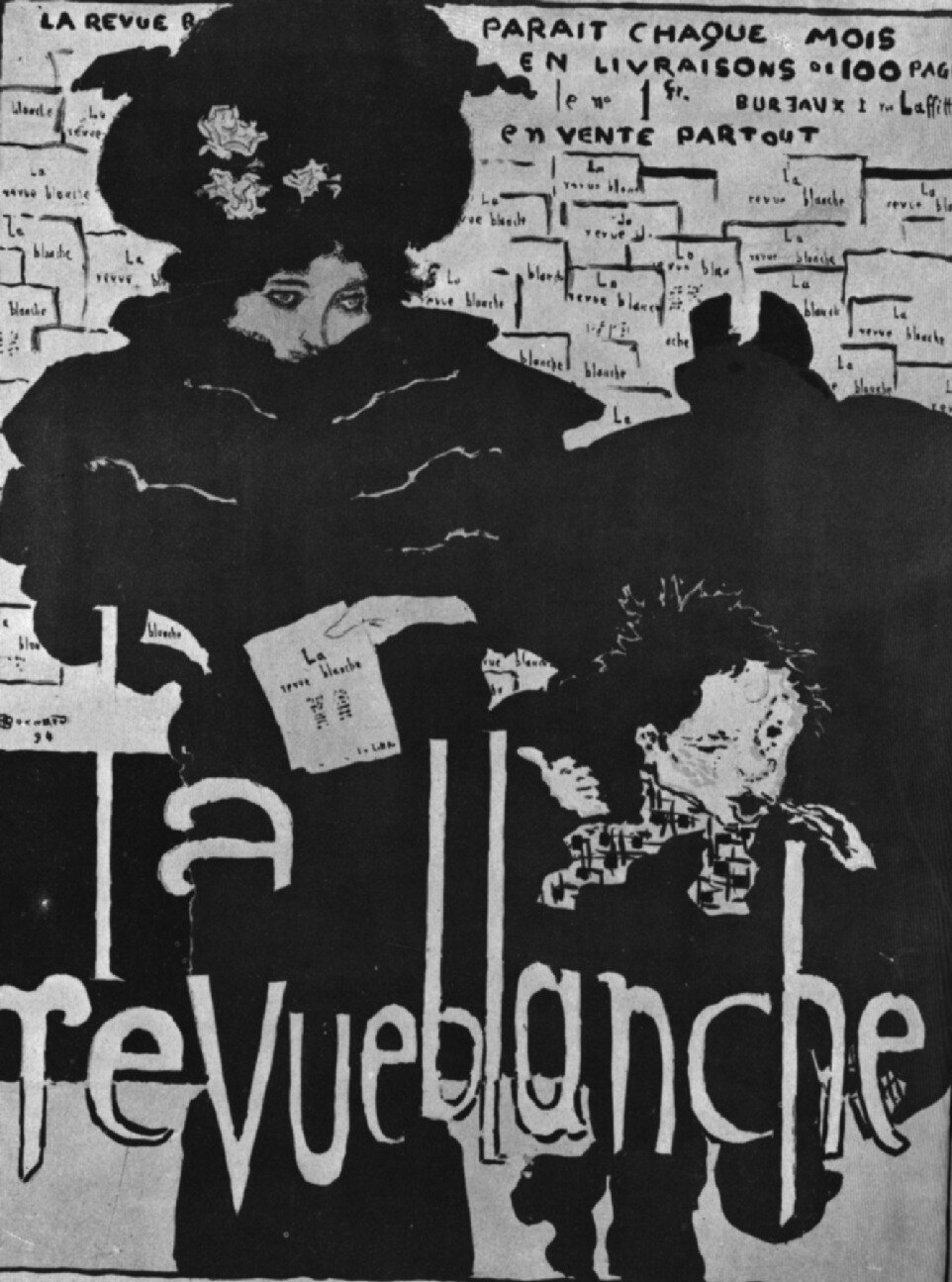
Paul Signac. "From Delacroix to Neo-Impressionism." La Revue Blanche, 1899
 Georges Seurat. Eiffel Tower. 1889. 24 X 15. San Francisco, The Fine Art Museum
Neo-Impressionist dots do not, but divided. Now divide it
:
sure all the benefits of brightness, color and harmony by:
:
sure all the benefits of brightness, color and harmony by:
1 ° The optical mixture of pigments only pure (all colors of the prism and all shades )
2 ° The separation of the various elements (local color, highlight color, their reactions, etc.).
3 ° The balance of these elements and their proportion (under the laws of contrast, of la dégradation et de l'irradation) ;
4° Le choix d'une touche proportionnée à la dimension du tableau.
Paul SIGNAC. « D'Eugène Delacroix au néo-impressionnisme ». La Revue Blanche , 1899
 Georges SEURAT. Le Chahut. 1889-1890. 169 X 139. Otterlo, Musée Kröller-Müller
Admirers of Seurat often regret his method, the little dots. Imagine, Renoir said, Veronese's Marriage at Cana done in petit point. I cannot imagine it, but neither can I imagine Seurat's pictures painted in broad or blended strokes. Like his choice of tones, Seurat's technique is intensely personal. But the dots are not simply a technique; they are a tangible surface and the ground of important qualities, including his finesse. Too much has been written, and often incorrectly, about the scientific nature of the dots. The question whether they make a picture more or less luminous hardly matters. A painting can be luminous and artistically dull, or low-keyed in color and radiant to the mind. Besides, bow to paint brightly is no secret requiring a special knowledge of science. Like Van Gogh, Seurat could have used strong colors in big areas for a brighter effect. But without his peculiar means we would not have the marvelous delicacy of tone, the uncountable variations within a narrow range, the vibrancy and soft luster, which make his canvases, and especially his landscapes, a joy to contemplate. Nor would we have his surprising image-world where the continuous form is built up from the discrete, and the solid masses emerge from an endless scattering of fine points - a mystery of the coming-into-being for the eye. The dots in Seurat's paintings have something of the quality of the black grains in his incomparable drawings in conte crayon where the varying density of the grains determines the gradations of tone. This span from the tiny to the large is only one of the many striking polarities in his art.
If his technique depends on his reading of science, it is no more scientific than the methods of flat painting; it is surely not better adapted to Seurat's end than was the technique of a good Egyptian painter to his own special goals. Yet was Seurat's aim simply to reproduce the visual impression by more faithful means? Certain phrases in his theoretical testament - a compact statement of two pages - might lead us to think so; but some passages that speak of harmony and contrast (not to mention the works themselves) tell us otherwise. He was interested, of course, in his sensations and the means of rendering them, as artists of the Renaissance were passionately interested in perspective. When used inventively, perspective had also a constructive and expressive sense. In a similar way, Seurat's dots are a refined device which belongs to art as much as to sensation - the visual world is not perceived as a mosaic of colored points, but this artificial micro-pattern serves the painter as a means of order portioning and nuancing sensation beyond the familiar qualities of the objects that the colors evoke. Here one recalls Rimbaud's avowal in his Alchemy of the Word : « I regulated the form and the movement of each consonant », which was to inspire in the poets of Seurat's generation a similar search of the smallest units of poetic effect.Seurat's dots may be seen as a kind of collage. They create a hollow space within the frame, often a vast depth; but they compel us also to see the picture as a finely structured surface made up of an infinite number of superposed units attached to the canvas. When painters in our century had ceased to concern themselves with the rendering of sensations - a profoundly interesting content for art - they were charmed by Seurat's inimitable dots and introduced them into their freer painting as a motif, usually among opposed elements of structure and surface. In doing so, they transformed Seurat's dots - one can't mistake theirs for his - but they also paid homage to Seurat.
Seurat's dots, I have intimated, are a means of creating a special kind of order. They are his tangible and ever-present unit of measure. Through the difference in color alone, these almost uniform particles of the painter modulate and integrate molar forms; varying densities in the distribution of light and dark dots generate the boundaries that define figures, buildings, and the edges of land, sea and sky. A passionate striving for unity and simplicity together with the utmost fullness appears in this laborious method which has been compared with the mechanical process of the photo-engraved screen. But is it, in the hands of this fanatical painter, more laborious than the traditional method with prepared grounds, fixed outlines, studied light and shade, and careful glazing of tone upon tone ? Does one reproach Chardin for the patient work that went into the mysterious complex grain of his little pictures ? Seurat practices an alchemy no more exacting than that of his great forebears, though strange in the age of Impressionist spontaneity. But his method is perfectly legible; all is on the surface, with no sauce or secret preparations; his touch is completely candid, without that "infernal facility of the brush" deplored by Delacroix. It approaches the impersonal but remains in its frankness a personal touch. Seurat's hand has what all virtuosity claims : certitude, rightness with least effort. It is never mechanical, in spite of what many have said - I cannot believe that an observer who finds Seurat's touch mechanical has looked closely at the pictures. In those later works where the dots are smallest, you will still discover clear differences in size and thickness; there are some large strokes among them and even drawn lines. Sometimes the dots are directionless, but in the same picture you will observe a drift of little marks accenting an edge.
With all its air of simplicity and stylization, Seurat's art is extremely complex. He painted large canvases not to assert himself nor to insist on the power of a single idea, but to develop an image emulating the fullness of nature. One can enjoy in the Grande Jatte many pictures each of which is a world in itself ; every segment contains surprising inventions in the large shapes and the small, in the grouping and linking of parts, down to the patterning of the dots. The richness of Seurat lies not only in the variety of forms, but in the unexpected range of qualities and content within the same work : from the articulated and formed to its ground in the relatively homogeneous dots ; an austere construction, yet so much of nature and human life; the cool observer, occupied with his abstruse problems of art, and the common world of the crowds and amusements of Paris with its whimsical, even comic, elements; the exact mind, fanatic about its methods and theories, and the poetic visionary absorbed in contemplating the mysterious light and shadow of a transfigured domain. In this last quality - supreme in his drawings - he is like no other artist so much as Redon. Here Seurat is the visionary of the seen as Redon is the visionary of the hermetic imagination and the dream.
Seurat's art is an astonishing achievement for so young a painter. At thirty-one - Seurat's age when he died in 1891 - Degas and Cézanne had not shown their measure. But Seurat was a complete artist at twenty-five when be painted the Grande Jatte . What is remarkable, beside the perfection of this enormously complex work, is the historical accomplishment. It resolved a crisis in painting and opened the way to new possibilities. Seurat built upon a dying classic tradition and upon the Impressionists, then caught in an impasse and already doubting themselves. His solution, marked by another temperament and method, is parallel to Cézanne's work of the same time, though probably independent. If one can isolate a single major influence on the art of the important younger painters in Paris in the later '80s, it is the work of Seurat ; Van Gogh, Gauguin and Lautrec were all affected by it.
Meyer Schapiro. Modern Art, Nineteenth and Twentieth Century. 1978