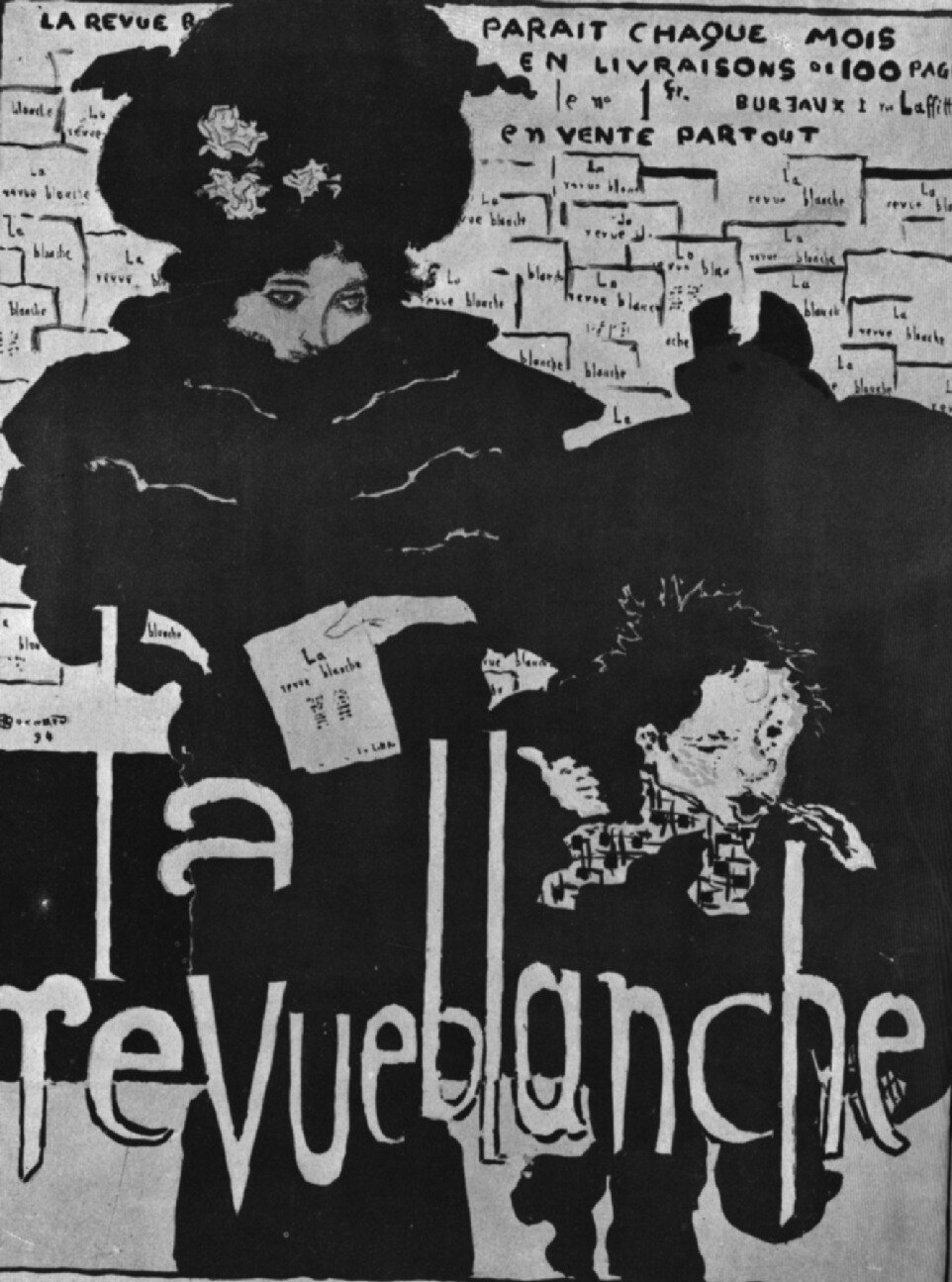
 Pierre Bonnard. Poster for La Revue Blanche . 1894
http://bibliobs.nouvelobs.com/2007/11/21/la-maison-blanche
 Felix Vallotton. Portrait of Felix Feneon, secretary of the Revue Blanche .
The magazine, in April 1903, ended its publication, lack of success to ensure its financial stability is not a review as the others. With the perspective that gives us the century, it is no longer any doubt that this was a place with no equivalent in French cultural history since both the Revue Blanche has been both a member typical of the literature of "vanguard" in the same way but not less than Le Mercure de France, his contemporary, but at the same time, and that's more rare, art magazine of the young plastic creation, around the "Nabis", before being, finally, what did not expect it at first, the center of a network policy at the time of the Dreyfus Affair in sets of French society and a deep cleavage, for many decisive. The adventure had begun yet very modestly in 1889 as a thin notebook Franco-Belgian, started by a group of young amateur writers attracted by Barres and Mallarme: the "little magazine" of this end-of-century , as there were so many, and very ephemeral.
From the first month, however, even before the siege, printing and real center of gravity of the review were not permanently gone from Wallonia in Paris, a family will occupy the center of the company and to ensure its stability, family Natanson, translated here into a family of three members, Alexander, and Thaddeus Louis Alfred, that it is important to add the second wife, the seductive Misia, Misia Sert future, perfect type of artistic muse. Alexander is the director of the magazine, which he will manage the most balanced compatible with the role of patron expensive that the family, trained in this field mainly by the younger brother, Thaddeus, would play with young artists called Bonnard, Vuillard, Signac, Maurice Denis, Toulouse-Lautrec and Vallotton. The daily survival of the magazine will, in turn, the work of two sub-editors harsh critic Lucien Muhlfeld, died prematurely, then the very discreet and very radical Fénéon Felix, whose face inspires explicitly Jean Paulhan.
The climax of the journal is between 1893 and 1900. The seat moves from the rue des Martyrs in the Rue Lafitte, the magazine offers luxury prints and illustrated numbers - objects at the outset of a lively and strong insightful speculation - order a poster campaign in Toulouse-Lautrec and finally created his own publishing house, which also used some of the summary of the journal, will publish the Sienkiewicz's Quo Vadis or Thousand and One Nights Dr. Mardrus. Because it's good that this summary: even if all these names do not appear simultaneously in the same issue, the Journal white is that, in light of history, can boast of having was not only as employees but for occasional columnists a Leon Blum, a Claude Debussy, a Andre Gide, an Alfred Jarry, a Charles-Louis Philip.
But the regular presence of criticism now forgotten or ignored as Gustave Kahn poetry, Willy Fagus for music or for art is no less at the time for the reputation of the journal, past from monthly to bimonthly in 1895 and has twelve thousand subscribers at the beginning of the twentieth century.
For some numbers, the magazine opened a section devoted to the occult, another - more surprising - the sport shared by Blum and Tristan Bernard. The presence of the latter, host of two supplements comedy called The Hunter and hair Nib, a measure of the magnitude of the aesthetic field covered, ranging from Mallarme to elegant forms of vaudeville (Pierre Veber, Romain Coolus), through these "friends of the review "that name Jules Renard and Marcel Proust.
Refusing to be doctrinaire, the White could eventually move to eclectic. She comes out of this contradiction by opening with a curiosity never tired of foreign arts, drama Strindberg to Japanese prints, or by launching a series of Parisian life investigated both cultural (the influence of Scandinavian letters) and political (in memory of the Commune). But it is the policy that finally will give the magazine its historic role as the original, while it will open up within it a latent crisis that may help to hasten its end. Consists largely of fans enough Barres, the Revue Blanche will take effect from 1898, clearly in favor of Captain Dreyfus and it is in his column that the rare Lucien Herr, librarian of the street to Ulm, rallied to the cause, will release the text as rare break collectively addressed by the Master of those disciples who have chosen this camp. The summary, like the full catalog, feel this commitment is marked by an increased focus on topics from political, geopolitical and social issues. From this period dates the arrival of young analysts referred to as spirited Charles Peguy or Julien Benda, who is their true debut as polemicists.
If one seeks the equivalent, approximately, if not a "party" at least from a staff of Dreyfus, it is here we find him. Still, this warping overwhelms not everything and that if Felix Feneon, friend of the anarchist, is convinced Dreyfus, the same sub-editor who organizes the premises of the magazine at the same time, the first major exhibition Seurat. The latest evidence of the fruitfulness of the Journal is also looking into his life after death: a little fortune through designers have defended it before the others, Claudel Jarry, but many also in the model that it inspires two magazines launched after 1903 that, one more political, more cultural one, will share his legacy of fact by appearing to want it distinction but each with its management team of former White : the Journal of the Fortnight and The French Nouvelle Revue .
Pascal ORY. "Death of the White Review, April 1903", 2003


0 comments:
Post a Comment