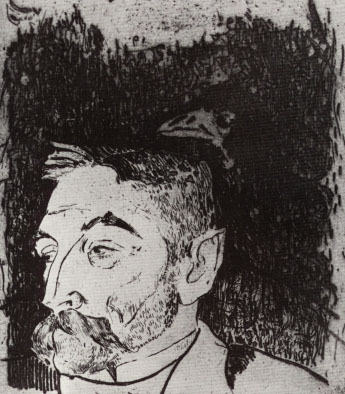
 Paul Gauguin. Stephane Mallarme. Etching. 1891
It was useful, before proceeding to study the formula, to hear the vows and theories of art of those who are still being debated, those who claim to conquer the future and who present themselves as vainquers tomorrow. At this point in my investigation, I felt it necessary to give voice to the symbolist-decadent, too well known to our readers for that is useful to present them.
I began with the Precursors.
M. Stephane Mallarme
One of the most widely loved writers of the literary world, with Catullus Mendes. Average height, graying beard, trimmed to a point, a large straight nose, long pointed ears of a satyr, eyes widely split, shines extraordinary expression of a singular delicacy tempered with an air of great kindness. When he speaks, the gestures always accompany the word, a gesture many, full of grace, precision, eloquence; voice lagging a bit on the ends of words gradually softening: a powerful charm emanates from the man in whom we sense a pride immarcessible, hovering above all, a pride of god or enlightenment to which he must immediately inwardly bow - when it was included.
- we are seeing now, a truly amazing spectacle, unique in the history of poetry from each poet, in his corner, playing a flute, his own, the air that he pleases, for the first time since the beginning, most poets do not sing in the choir. So far, is not it, you had to be accompanied, the organ of the official meter. Well, we had played too much, and it is sick. In dying, the great Hugo, I am sure, was convinced he had buried any poetry for a century, yet Paul Verlaine had written Wisdom, we can forgive this illusion to that which both accomplished miracles, but he reckoned without the eternal instinct, perpetual and inescapable thrust lyric. Above all, it lacked the unmistakable notion: that in a society without stability, without unity, he can not create permanent art, art final. This organization Social unfinished, which also explains the anxiety of mind, born the unexplained need for individuality with these literary events are a direct reflection.
More immediately, which explains the recent innovations is the realization that the old form of verse was not the absolute form, unique and unchanging, but a way to make sure good worms. We told the children: "Do not steal, you're honest!" True, but that's not all; outside the precepts enshrined, is it possible to write poetry? We thought so and I think it was right. The verse is everywhere in the language of rhythm there, everywhere except in posters and on the fourth page of newspapers. In the genre called prose, there are verses, sometimes admirable, all rhythms. But in truth, there is no prose: there is the alphabet, and then to more or less tight, more or less diffuse. Whenever there is an effort to style, there versification.
I told you earlier that if we arrived to the present, it is especially to be weary of official, his supporters share the same weariness. Is not that something very unusual that by opening any book of poetry is to be sure find an end to the other, rhythms and agreed uniform where it is claimed, however, our attention to the essential range of human emotions! Where is the inspiration, which is unexpected, and what weariness! To the official should serve only in moments of crisis of the soul, the poets today have understood, with a delicate sense of reserve, they wandered around, approached with a strange shyness, it seems some terror, and instead of making their principle and their starting point, suddenly did arise as the culmination of the poem or the period!
Moreover, in music, the same transformation occurred: the melodies of old comic succeeds very endless broken melodies that enrich the fabric without the pace that we feel so strongly marked.
- It's nice here - I asked - came the split?
- Yes. The Parnassians lovers to strict, fine by itself, did not see that there is an effort supplementing their own; effort which had the same time the advantage of creating a kind of to the great interregnum harassed and begged for mercy. For be it known that tests of the latest arrivals do not tend to delete the large and tend to put more air in the poem, creating a sort of fluidity, mobility between the verses of large jet they lacked a bit far. You hear all of a sudden in the orchestras of beautiful pieces of copper, but we feel very well that if it were only that, they're tired quickly. Youth space out these great features to make them appear not only when they have to produce the total effect: thus the Alexandrian, and no one has invented that has sprung from his own instrument language, instead of being manic and sedentary as at present, will now be freer, more unexpected, more airy, and it takes the value of being used only in severe movements of the soul. And the volume of poetry will be the future which will run through to the grand original with endless motifs to hearing individual.
So there is division by unawareness of both sides that the efforts can reach rather they are destroyed. For if, on one side, the Parnassians were, in fact, the absolute slaves of worms, sacrificing them to their personality, young people are drawn directly from their instinct music, as if nothing had happened before, but they do an area the stiffening Parnassian constriction, and I think the two efforts can complement each other.
These opinions do not prevent me to believe, personally, with the wonderful science of worms, the supreme art of cuts that have teachers like Banville, the Alexandrian can reach an infinite variety, follow all the movements passion possible: Blacksmith Banville, for example, has endless Alexandrian, and others, instead of an incredible brevity. But this instrument so perfect, and which was perhaps a bit worn, it was not bad he rested, really.
- So much for the form, I say to Mr. Stephane Mallarme. And the bottom?
- I think he answered that, in substance, young people are closer to the poetic ideal that Parnassiens that still treat their subjects in the manner of old philosophers and rhetoricians of old, presenting objects directly. I think we should, instead, there is allusion. The contemplation of objects, the image of flying dreams aroused by them, are singing: the Parnassians them take the whole thing and show it, thus they lack mystery, they remove the spirits that delicious joy of believing they create. Naming an object is remove three quarters of the enjoyment of the poem that is made of happiness to guess little by little to suggest, is the dream.
is the perfect use of that mystery which is the symbolism: gradually raise an object to show a mood or, conversely, choose an object and reach a state of mind, a series of deciphering.
- We are coming here, I said to the master of a big objection I had to make you ... Darkness!
- is, indeed, equally dangerous, he replied, is that darkness comes from the lack of drive, or the poet ... but that is cheating to evade work. What if a being of average intelligence, and inadequate preparation literary, accidentally opens a book and enjoy it and pretends that there is misunderstanding, we must put things in their place. There must always be enigma in poetry, and that is the purpose of literature - there is no other - to discuss the objects.
- Is it you, master, I asked, - which have created the new movement?
- I abominate schools, he said, and anything resembling it, I hate anything that is applied to professors of literature, which she, however, is quite individual. For me, the case of a poet in this society that does not allow him to live is the case of a man who isolates himself to sculpt his own tomb. What gave me the attitude of head of school is, first, that I'm always interested in ideas of young people, then it's probably my sincerity to recognize that it was new in the provision of latecomers. For me, basically I'm a loner, I think that poetry is for the pomp and pumps regularly constituted supreme company would have a place where the glory that people seem to have lost the concept. The poet's attitude in times like this where it is on strike against the company is putting aside all tainted means who can afford him. All we can offer him is less than its design and its secret work.
I ask what place is Mallarme Verlaine in the history of poetic movement.
- He was the first who reacted against the sinlessness and impassivity Parnassian and has made in wisdom, to his fluid, with already dissonance necessary. Later, around 1875, my Afternoon of a Faun, with a few friends, like Mendes and Dierx was screaming the whole Parnassus, and the piece was rejected with a large ensemble. I was trying, in effect, to put beside the Alexandrian in his entire holding a sort of running game tinkles around, as it were a musical accompaniment made by the poet himself and not to allow the Official go out only on special occasions. But the father, the true father of all Young is Verlaine, Verlaine, the beautiful which I find attitude as a man as beautiful as a writer really, because that's the only one at a time when the poet is an outlaw, who can accept all the pain with such height and such a great swagger.
- What do you think of the end of naturalism?
- The childishness of the literature so far has been to believe, for example, choose a number of precious stones and put names on paper, even very good, it was making gemstones . Well, no! The poetry of creation, must be taken into the human soul states, glimmers of purity so absolute that, well sung and well illustrated, this is indeed the jewels of man: there he is a symbol, it is created, and the word poetry has meaning here: c ' is, in fact, the only possible human creation. And if, indeed, precious stones which were adorned not showing a state of mind, it is unfair that barrier ... Women, for example, that eternal thief ...
And look, my interlocutor said, laughing, half what he is admirable in new stores, it is revealed to us by the Commissioner of Police, the woman appears to be unduly from what she did not know the hidden meaning, and does therefore not belong to him ...
To return to naturalism, it seems it must mean the literature of Emile Zola, and that the word die for when Zola has completed his work. I have great admiration for Zola. He made less, indeed, real literature than art evocative, using the least it is possible, literary elements and has taken the words, true, but it while the remainder comes from its superb organization and is reflected immediately in the spirit of the crowd. He really powerful qualities, his incredible sense of life, its crowd movements, the skin of Nana, we all cherished the grain, all painted in washes of prodigious is the work of an organization truly admirable! But literature is something more intellectual than that: things exist, we do not have to create them, we need only grasp the relationship, and it is the son of such reports that make worms and the
- Do you know the psychologists?
- A little. It seems that after the great works of Flaubert, the Goncourt, and Zola, who are like poems, we came back today to the old French style of the last century, much more humble and modest, which is not to be taken to painting his means to show the external form of things, but to dissect the motives of the human soul. But there, between that and poetry, the same difference between a corset and a nice groove ...
I asked, before leaving, Mr. Mallarme, the names of those he claims, changes in current poetic.
- Young people, he replied, which I seem to have made out of control, that is to say original work, not related prior to anything, it Morice Moreas a delicious singer, and especially one who has so far yielded the highest shove, Henri de Regnier, who, like Vigny, lives there A little later, in retirement and silence, and before whom I bow in admiration. His latest book: Poems old and romantic, is a pure masterpiece.
- Basically, you see, "said the teacher, shaking my hand, the world is to achieve a beautiful book.
PS - I met Mr. Stéphane Mallarmé, who was surprised not to have seen included the names of MM. Viele-Griffin and Gustave Kahn the record of my interview with him: "What are me he said, two of the major poets who have contributed to the movement and symbolic that I had designated purpose."
I must admit that these two names were, in fact, remained in my inkstand, and I am very happy to seize the opportunity presented to me to give them to the place it belongs.
Jules Huret. "Survey of literary evolution: Stephane Mallarme." L'Echo de Paris. Literary journal and political morning. March 14, 1891


0 comments:
Post a Comment