In painting, there are two things: the eye and brain, both need each other: we must work to their mutual development, in the eye by the vision of nature to the brain by the logic of organized sensations, which give the means of expression.
should get an optical. I mean by a vision optical logic.
I would like to join (the nature and art). Art is a personal apperception. I put this apperception in sensation and ask for the understanding of the organization in place.
Making Impressionism something solid and lasting like the art museums.
Everything, especially in art, theory developed and applied in contact Nature.
must regain the classical kind, that is to say by the sensation.
The sensation is the foundation of everything, I will repeat it incessantly.
Painting from nature is not copying the objective is to realize his feelings.
Nature is not on the surface, it is deep. These colors are an expression at the surface, this depth.
Drawing and color are more distinct as and as we painted, draw, more color harmonizes, the more the drawing is accurate ... When color is at its richness, the form is in its fullness.
"Cézanne did not feel forced to choose between feeling and thought, as between chaos and order. It does not separate the things that appear fixed in our gaze and their elusive way of appearing, he wants to paint the subject now is to shape the emerging order in a spontaneous organization. It does not break between the "meaning" and "intelligence", but between the spontaneous order of things perceived and the human order of ideas and science. We perceive things we agree on them, we are anchored in them and on this foundation of "nature" that we build science. It is this primordial world that Cezanne wanted to paint, and that is why his paintings give the impression of nature at its origin, while photographs of the same landscapes suggest the work of men, their amenities, their presence is imminent. "
Maurice Merleau-Ponty. Cézanne's Doubt .
"The design must result from the color, if one wants the world is rendered in its thickness as it is without a mass gap, an organization color, through which the leak of perspective, the contours, lines, curves settle as lines of force, as part of space itself into a vibrant "
Maurice Merleau-Ponty. Cézanne's Doubt .
virginity I breathe in the world. A keen sense of the nuances I worked. I feel stained by all the nuances of infinity. At that time, I am one with my picture. We are an iridescent chaos. I come before my motive, I am confused. I dream wave. The sun penetrates me softly, like a distant friend that warms my laziness, fruitful. We germinons.
Paul Cezanne, quoted by Joachim Gasquet. Cezanne. Paris, 1926.
If I go too high or too low, everything is rocketing. Do not think there is a single loose mesh, a hole where the emotion, light, truth escape. I lead, understand a little, my whole canvas at once, as a whole. I compare in the same spirit, the same faith, all that scattered ...
Paul Cezanne.
"I am afraid that all the old masters and paintings representing things in the open air have been made of chic, because this does not seem to have the appearance and especially true original that nature provides. "
" ... To the present time, I continue to seek the expression of those confused sensations which we bring into the world. "
"But after seeing the great masters who are buried (the Louvre), one must hasten to get out and invigorate itself, in contact with the nature, instincts, sensations of art residing in us. "(To Charles Camoin, 1903)
" For if the thrill of nature - and certainly I live - is the necessary foundation of any art design, on which rests the grandeur and the beauty of the future work, knowledge of ways of expressing our emotion is no less critical and can be acquired by a very long experience. "
" For progress to be made, there is the nature and educates the eye to contact. It becomes concentric strength to look and work. I mean that in an orange, an apple, a ball, a head, there is a high point and this point is still - despite the devastating effect: light and shade, coloring sensations - the closest to our eye; object edges are fleeing to a center placed on our horizon. "
"An optical sensation occurs in our visual organ, which makes us classify light, halftone or shift your plans represented by sensations coloring. (The light is not for the painter) "
" Art is a harmony parallel to nature (...) Imagine Chick completely redone on nature, here is the classic I hear. (...) The design and color are not distinct as and as we painted, draw, more color harmonizes, the more the drawing is accurate. When color is at its richness, the form is in its fullness. The contrasts and relations of tones, is the secret of drawing and modeling. (...) Let me repeat what I told you here: treat nature by the cylinder, the sphere, the cone, the whole thing in perspective, is that each side of an object, plan , goes to a central point. The lines parallel to the horizon give the spread, or a section of nature or, if you prefer, performing the Deus Pater Omnipotens Aeterne spreads before our eyes. Lines perpendicular to the horizon give depth. But nature for us men, is more in depth the surface, hence the need to introduce into our light vibrations, represented by the reds and yellows, a sufficient amount of blue, to feel the air. "
" Be sure the paint color is entering a phase of music. Cezanne, to quote a former seems to be a pupil of Cesar Franck. He constantly plays the great organ, which made me say it was polyphonic. "
Paul Gauguin, quoted Charles Morice. Paul Gauguin . Paris, 1923
"For him, the entire subject was human in nature, but between nature and human characters, he dreamed of a deep harmony. He wished them a resemblance intimate correspondence expressive, so that the table might reveal a higher entity to appearances where the genius of the painter himself could transpire. Because painting is an art for eternity. Human life and the sensitive nature are in constant change: the landscape never changes. At least then the real object to a contradiction inevitable, it is necessary that the artist emerges in man and in nature, FORM, WHAT DOES NOT CHANGE. Must make his work, as it timeless, in harmony.
"Paul Cezanne's painting, like the poetry of Mallarme, is in a sense, metaphysical.
"One day, in front of a painting by Cezanne, and in his presence, I expressed about these ideas, he exclaimed:" It's amazing! You say what I have here - I've never told anyone, I can not even not explain to myself! "
" ... However, "he said after a moment, I feel that I am not fully realized. Hold! look at this picture! (He worked there for months, a boorish head shaving river where all the words gushed from the eyes) ... They are not there yet eye: they do not come out! - If you take them out, "I said, that the soul will return. Cezanne dreamed of adding up the maximum expression of finish, the Balzac of Rodin had never fully satisfied that if, while remaining himself, he had become the bargain of Apollo Belvedere. "
Royer. The Phalanx , November 15, 1906
If Cezanne irreparably separated into two camps those who love painting and those who prefer to paint her own amenities accessories, literary or autres.Le mystery which has surrounded the master of Aix-en-Provence has done much to increase the darkness of the comments which has, on the other hand, enjoyed his fame. It is a shy, an independent, a loner. exclusively occupied with his art, constantly anxious and often ill-satisfied with himself, he escaped to his last years in the public eye. Even those who claimed his methods are the most ignoré.A a time when the sensitivity of the artist was held almost unanimously for the sole reason for the artwork, and where improvisation - this "spiritual vertigo from the exaltation of the senses" - tended to simultaneously destroy the outmoded conventions of the academy and the methods needed, it came to the art of Cezanne was able to keep its essential role sensitivity while substituting reflection to empiricism. And, for example, instead of scoring clotting phenomena, he could keep his emotion of the moment, while tiring almost to a fault, a calculated and wanted to work, his studies from nature. He composed his still lifes, ranging purposely lines and masses, draperies with different rhythms premeditated, avoiding accidents of chance, looking for plastic beauty, but without losing the real reason, this initial pattern that captures bare in his sketches and watercolors, I mean this delicate symphony shades juxtaposed, discovered that her eye first, but his reason was immediately and spontaneously press the logical support of a composition, plan, architecture.
Maurice DENIS. Theory (1890-1910). Symbolism and Gauguin to a new classical order , 4th edition. Paris, 1920
"I need to know the geology, how rooted (...) Sainte-Victoire. (...) If I share the thrill with others, will not they have a more universal sense of obsessive perhaps, but how much more fruitful and more delicious "

Paul CÉZANNE.
Les Grandes Baigneuses. 1898-1905. 208 X 249. Philadelphia Museum of Art
***
After fifty years of the most radical change in art from images to free abstraction, Cézanne's painting, which looks old-fashioned today in its attachment to nature, maintains itself fresh and stimulating to young painters of our time. He has produced no school, but he has given an impulse directly or indirectly to almost every new movement since he died. His power to excite artists of different tendency and temperament is due, I think, to the fact that he realized with equal fullness so many different sides of his art. It has often been true of leading modern painters that they developed a single idea with great force. Some one element or expressive note has been worked out with striking effect. In Cézanne we are struck rather by the comprehensive character of his art, although later artists have built on a particular element of his style. Color, drawing, modelling, structure, touch and expression - if any of these can be isolated from the others - are carried to a new height in his work. He is arresting through his images - more rich in suggestive content than has been supposed - and also through his uninterpreted strokes which make us see that there can be qualities of greatness in little touches of paint. In his pictures single patches of the brush reveal themselves as an uncanny choice, deciding the unity of a whole region of forms. Out of these emerges a moving semblance of a familiar natural world with a deepened harmony that invites meditation. His painting is a balanced art, not in the sense that it is stabilized or moderate in its effects, but that opposed qualities are joined in a scrupulously controlled play. He is inventive and perfect in many different aspects of his art.
In this striving for fullness, Cézanne is an heir of the Renaissance and Baroque masters. Like Delacroix, he retains from Rubens and the Italians a concept of the grand - not in the size of the canvas but in the weight and complexity of variation. His grandeur is without rhetoric and convention, and inheres in the dramatic power of large contrasts and in the frankness of his means. His detached contemplation of his subjects arises from a passionate aspiring nature that seeks to master its own impulses through an objective attitude to things. The mountain peak is a natural choice for him, as is the abandoned quarry, the solitary house or tree, and the diversity of humble, impersonal objects on the table.
The greatness of Cézanne does not lie only in the perfection of single masterpieces; it is also in the quality of his whole achievement. An exhibition of works spanning his forty years as a painter reveals a remarkable inner freedom. The lives of Gauguin and Van Gogh have blinded the public to what is noble and complete in Cézanne's less sensational, though anguished, career. Outliving these younger contemporaries, more fortunate in overcoming impulses and situations dangerous to art, he was able to mature more fully and to realize many more of his artistic ideas.
Cézanne's masterliness includes, besides the control of the canvas in its complexity and novelty, the ordering of his own life as an artist. His art has a unique quality of ripeness and continuous growth. While concentrating on his own problems - problems he had set himself and not taken from a school or leader - he was capable of an astonishing variety. This variety rests on the openness of his sensitive spirit. He admitted to the canvas a great span of perception and mood, greater than that of his Impressionist friends. This is evident from the range of themes alone; but it is clear in the painterly qualities as well. He draws or colors; he composes or follows his immediate sensation of nature; he paints with a virile brush solidly, or in the most delicate sparse watercolor, and is equally sure in both. He possessed a firm faith in spontaneous sensibility, in the resources of the sincere self. He can be passionate and cool, grave and light; he is always honest.
Cézanne's work not only gives us the joy of beautiful painting; it appeals too as an example of heroism in art. For he reached perfection, it is well known, in a long and painful struggle with himself. This struggle can be read in his work in the many signs of destructiveness and black moods, especially in his early phase ; perhaps we may recognize it too even in the detached aspect of the world that he finally shapes into a serenely ordered whole. I do not doubt that the personal content of this classic art will in time become as. evident as the aesthetic result.
Meyer SCHAPIRO. Modern Art, Nineteenth and Twentieth Centuries. 1978-1979.
***
Paul Cézanne aura été essentiellement un Provençal. Il devait garder toute sa vie, dans son parler, un fort accent méridional, il a toujours conservé a clip with his homeland and ended, after having left, return to live by. He never left anything to see, in Paris, Paris. Provence is now the only part of France, which has resisted the influence of absorbing Paris, who has kept a clean soul and a life. She maintained, to some extent, its traditions, its language and has produced men deeply conscious of the land, men like Mistral, Monticelli and also Cezanne.
Cezanne has been primarily owes its character to its country of origin. All those called the Impressionists, he has been in reality the less impressionistic. Particularities, which are the common traits of Impressionism, it has taken in the middle of Paris, where he developed his art, were simply superimposed on the merits of simple style, simplicity, order, which comes its soil, old Latin training.
He was born in Aix-en-Provence, January 19, 1839. He was the son of a man who became a wealthy banker and live out of town a house in a park (the Jas de Bouffan). He went to college in Aix in 1853. He was there with Emile Zola, whose father, an engineer, was building a canal at Aix and he became close with him friendship. He came out of college at age 19, bachelor. It follows, 186o-1861, courts of law school, takes several inscriptions and even pass the first exam. The study of law is disgusted, he abandons.
Her artistic vocation was growing. It was felt early passion for drawing. It expresses, in abandoning the study of law, the intent to engage in painting. There comes a time in Paris in 1862, led by his father. He attended the Academie Suisse, but failed in the competition for admission to the Ecole des Beaux-Arts. Returned to Aix, in the wake of this failure, He enters the office of his father's bank. This kind of life he immediately becomes unbearable and of course, the call of vocation is being increasingly felt, he won in 1863, returning to Paris, where he will engage himself entirely to painting. His father awarded him a pension of one hundred and fifty francs per month, soon increased to three hundred, it will always be regularly paid.
Cezanne found Emile Zola in Paris. They continue their old camaraderie and lead a sort of common life. We can see from the correspondence of Zola, which had intercourse in their youth, drawn up between them. At the time of maturity, so that their talents would be completely fulfilled, their divergent temperaments, their different work patterns, the way of feeling dissimilar, would lead them to deviate more or less, each confined to his own field, but there was never a break. And when at the beginning of 1906, was officially opened at the Library of Aix, a bust of Zola, Cézanne attend the ceremony and will prove deeply moved by the honor paid to his old friend.
Cezanne came to Paris goes to work. He attended the Academie Suisse, on the Quai des Goldsmiths. After the first learning, it takes a workshop Beautreillis street and begins to produce. But it will take time, even a long time to develop its full originality. It was these men who have their faculties as hidden in the depths of themselves and who, to make them clear and fertilize, require a sustained effort. There has never in his virtuosity, easy work and improvisation him remain unknown. The time will come, an essential element in the release of its originality, and in the training of various kinds and even cultivate it in the performance of each of his works salient, specific. But, as Alceste, time does not matter.
At first, a man who seeks it undergoes major influences when practiced on young people enfranchised, those of Delacroix and Courbet. Romanticism and the palette of Delacroix have seduced the former. Was it a number of works of pure romance. The most significant part of the sale Zola, in March 1903 under the title The Abduction. However the action of Delacroix is only temporary, such as Courbet, who was to be deeper and longer lasting, succeeded him. He knows Courbet. The realism of Courbet corresponded in substance at its way of being, as the works he produced under this influence they are relatively numerous.
Zola in 1866, charged by Mr. de Villemessant accountability in the event of the Show had enthusiastic praise of Manet, which caused a huge scandal. He had, therefore, leave the event and interrupt his show. After it became the champion of Manet, it tied him with ongoing relationships. Cezanne in the close intimacy where he stood with Zola, the coup was led to Manet and his art. He no longer holds, from this moment, the range of staining by Courbet, he proceeded to that of Manet. He is running to develop the system of colors, which draw in its full originality.
must explain the influences on Cezanne does not mark different ways, absolutely trenches. This is, in his case, a very strong man, who first became involved in a certain way. Indeed, the designation of his subjects, the limits within which it intends to take were promptly fixed. Except the first time under the influence of Delacroix, he painted several compositions romantic, it has never been attracted by the spectacle of the visible world. He has not researched the subject descriptive, he ignored the literary borrowings. The abstract expression of feelings, emotional, it has remained unknown. He first spent to paint what can be seen through the eyes, still lifes, landscapes, portraits and heads or as a kind of coronation, the compositions, but simple order, where characters are placed side by side only to be painted.
The land on which it intends to take is immediately defined, when one speaks of the influences, it is really matters of technique, tonal range, values of range, it must first to the predecessors. It is therefore especially his coloring, which has passed through various stages before being fully established. It's appearance is changing and will change, until he takes his character through the adoption of the final painting in open air. The event occurred in 1873. At that Cezanne will reside in Auvers-sur-Oise. He met there with Pissarro and Vignon, who have long painted outdoors.
He began painting their example, taking our eyes to the bright colors, the brightness of the light gives the campaign. It was hardly far removed from the workshop, even his landscapes, as Snow melting from the sale Doria, were executed inside, away from the natural scene shown. When Cézanne began systematically to paint outdoors, in Auvers, he was 33, he worked for a long time, he was in possession of certain means. Also in direct contact with nature and the vivid colors of the outdoors, it blooms in all its originality. It develops a range of color absolutely personal and unexpected, a great power.
Anyway, we must be careful to make a man imbued with revolutionary ideas and hostile feelings against former schools. He admired, as much as anyone, old masters, Poussin in particular, he knew very well having visited the Louvre. Original approach has traced a path clean, it intended to follow without deviation, but after that he had nothing better than to please the public and participate in official exhibitions, enjoying the benefits of any kind that may obtain.
He had stubbornly sought to be receiving the Salons for years. There were presented before and after 1870, tables invariably refused. It is this inability to penetrate Shows that led to a large extent, to unite artists would be called the Impressionists. He had, upon his arrival in Paris, is primarily knowledge of Pissarro and Guillaumin, then that of Renoir and Monet. So he joined them to take part in the first exhibition at Nadar they organized in 1874, boulevard des Capucines.Il put there as the main composition, the House of Hangman, now in the collection of Camondo the Louvre, painted in Auvers in 1873. The name came from the fact that the occupant of the house it was suicide. This painting is certainly room to see the distinctive gifts of its author, who does not like discovers, as in others he painted in the same period in Auvers, the influence of Pissarro, with whom he had first started working outdoors. However, in the Impressionist exhibition of 1874 than in 1877, Cezanne was reached, he entered into full possession of the art of the outdoors. It exposes then sixteen paintings and watercolors, still lifes, flowers, landscapes and a man's head, the portrait of M. Choquet. These works show reached its full originality.
At the exhibition of 1877, rue Le Peletier, the Impressionists, occurring in all their boldness, raised a general horror and made public the fact of monsters and barbarians. But one of them all the horror that caused the most profound, more specifically than any other was the effect of a true barbarian, a real monster, it was Cézanne. In 1877 the memories of the Commune were still alive and if the Impressionists were then generally treated as "Communists", they had mostly to his presence in their midst.
It is likely that we will never be unleashed, a painter cons whatsoever, the hostility that the Impressionists had to endure. Such a phenomenon can not be repeated. Where the Impressionists, where wilt has given way to admiration, has warned opinion. It will surely warning and will prevent an uprising like the one we've known, never happens more against the innovative and original, which may still occur. If it must be so, Cezanne has provided an example called to remain single. If the Impressionists are destined to remain the painters who have been abused all over their appearance, Cézanne, among them, was without comparison the most hated and has had the honor of being, of all original artists never appeared in the world, whoever has the most roared the Philistines. That with him the originality and appearance will manifest itself apart, so decided more than they had done before on the standard formulas of art easy, admitted free. You have to see where did that.
Cezanne was his first appearance in part to the fact that he had entered the workshop of any painter of renown, to learn to produce according to the current formula. Parisian studios have come to form an unlimited number of painters, who work according to rules so safe, we can say of their works they are impeccable. Hundreds of people show every year at the Salons, drawing and painting surfaces contours without defects. There was nothing wrong with their mailings. But all these people are alike, even technical, same invoice. Their work eventually excite the disgust of those who seek in art, originality and invention. But with the correction routine, it gives a general regularity of the design, appearance suitable forms, which were taken eyes so that everything that seems different to the public at fault, poorly designed, poorly painted.
But Cezanne, by way apart, came violently striking the banal taste, the usual audience. It was primarily a painter and did not draw by stopping lines and contours like the others. He applied, through a process personal touches on the canvas next to each other first, then the one above the other after. One can even say that in some cases it Maconnais his picture, and the juxtaposition and superimposition of colored buttons, plans, contours, the modeling had emerged, for those who could see, but for others were drowned in a mixture of uniform color.
foremost painter Cézanne, in the sense of the word, seeking first the quality of the substance and power of the painted colors. But then for those who do not understand the design flood with precise lines and decided it was not drawing, for those seeking to offer an array of anecdotal or historical reasons, not having his family were nothing like as not existing; for those who want covered surfaces as well, its done, for rough spots and elsewhere up to leave parts of the canvas uncovered, appeared to be that of a powerless, his touch, the juxtaposition of color tones equal or overlapping to arrive at the thickness seemed rude barbaric, monstrous.
But there was a special order quite superior in his works, but also precisely the sort that the public in general, writers and even ordinary painters can not initially understand or appreciate, First, since they can not even grasp it, is the intrinsic value of the material put on the canvas, the power of harmonious colors. Yet Cezanne's paintings offer a range of colors of an intensity high, with extreme clarity. It exudes a force independent of the subject, so a still life - a few apples and a towel on a table - will the size, the same degree as may do a human head or a landscape with the sea But the quality of the painting itself, which lies above the superiority of Cézanne, not being accessible to spectators while they took for their monstrous dying eyes, laughter, sarcasm, insults, shrugs, were the only evidence that his works should appear to them that both they deserve and they lavished.
Cézanne exhibitions of 1874 and 1877 therefore saw himself so utterly scorned, he felt so hopelessly misunderstood, that he would not for a long time to show the public. It should in fact take part in any other exhibitions organized by the Impressionists. But, folded in on itself, it will continue to paint the most diligent, most tenacious. It will perform non-stop to the practice of art. His case is so remarkable in the history of painting.
is a man who, showing his works, has been so abused that it fails to recover from back in the public eye. Nothing can give him foresee that the opinion will change him in the near future or never. So it's not that shimmers in the eyes of both others, fame, honors to acquire it works, since these benefits appear to be definitively rejected him. This is not for profit, because after the horror caused by his work, he has no chance of selling, or if it sells a few exceptional cases, it does obtained a small sum. Besides, he did not need to produce for a living, like so many others who, once engaged in the career, have to struggle against poverty. He has a pension from his father who feeds it, awaiting the day when the paternal inheritance will rich. It will continue to be painted by any of these reasons-usually decide the conduct of others. He continued to paint with pure purpose, by need to satisfy itself. He paints because it is made to paint. It was thus with him the example of a man, his organization necessarily leads to a certain task. Obviously he walked eye on things procured him so special feelings, he felt the need to fix the paint and in so doing, he felt the pleasure of a craving satisfied.
Because now paints only for himself, he painted this way it will best achieve the success it difficult designs. There will therefore be in their bill no trace of what might be called virtuosity, he will never do this easy work of the brush, giving roughly. It stems from a tightly. He keeps his eyes steadfastly fixed on the model or pattern, so that each key will be well, to help build on the canvas before him. It grows so far the integrity to make sincere object of his vision, he has such a horror of the work done chic, when in its execution, it is in places points on the web not covered, it leaves such which, without thinking about the cover, for a later work resumption parties initially neglected which engage all the others.
His system compels him to toil hard in some way. His paintings are apparently the simplest require considerable, often massive, sessions. His methods do not allow him to get that average achievement is certain that the others arrive. He started abandon many of his paintings, which remain in the state of sketches or drafts, or that the desired effect could not be obtained or that circumstances have prevented their completion. But then the works sent to the complete success will show off this sort of power that gives the accumulation of a tight labor remained free, however, providing strong and direct expression.
*
Cézanne took his party's philosophical contempt which he was the object. The idea never occurred to him one moment of change in anything, its own way, moving closer to the common taste. But he saw the exhibitions of 1874 and 1877 if absolutely despised it definitely felt so misunderstood, that he would not be-long to show the public. Once removed from public contact, for losing such exhibitions, he paints without worrying about what may happen around him.
When we say that he has waived the time to participate in exhibitions, this applies strictly to the exhibitions of the Impressionists, which is missing after 1877, but there is one exception. Incorporated in 1882, his desire to penetrate the Salons, he sent this year's portrait of a man. Quote, a friend of learning time, then a member of the jury did receive. The Salon of 1882 was thus the only one who, by chance, has seen a work of Cezanne.
Twenty years will elapse during which it will remain despised or ignored by the public, writers, collectors, dealers, men who give artists the fame and enable them to profit from their work. It will be appreciated that the small group of his friends painters, Pissarro, Monet, Renoir, Guillaumin who immediately considered a master, joined by some amateurs, who also want to have understood and its work. Count Doria was one of the first collectors to enjoy. He held an important meeting of paintings by Corot and the Masters of 1830. He added, after 187o, works of the Impressionists and especially The Hangman's House of Cezanne. Then he exchanged with this table for Choquet Slush who has been on its sale in May 1899.
With M. Choquet we have named the man who first felt a great admiration for Cézanne. He had in his youth in love with Delacroix, to the time when it was still generally despised and had thus been able, with modest resources, acquire a set of his works. After going instinctively to Delacroix, he then went instinctively to the Impressionists. He was a man of great politeness, which issued its opinions with heat, but always in the most respectful forms. He succeeded in this way to make themselves heard by many people at that time, would not have tolerated any other, a generally praised the Impressionists and Cézanne in particular. We met him at any place where the Impressionists were an opportunity to show their works, exhibitions and sales. It became a sort of apostle. He took one after the other visitors of his knowledge and crept among many others, to seek to penetrate his conviction and to share his admiration and pleasure.
Choquet in 1877 had a friendship with Cezanne, who passed when a portion of his time to paint for him in town and countryside. He painted several portraits of particular Choquet quite worked, one a head exposed Rue Le Peletier in 1877, another half-length, white dress, standing out against a background of green plants, painted outdoors in the countryside in Normandy in 1885. In July 1899, for sale after the death of Ms. Choquette, who had inherited her husband's collection, 31 paintings by Cezanne went to auction, the number was Mardi Gras, a big clown and harlequin, forming one of these subjects, where the characters are made especially for painting without engage in particular actions. It was at this sale that the prices of paintings by Cezanne, remained very low so far, began to climb to reach the elevation we see them today.
In 1870 and subsequent years a small shop, called the father Tanguy, selling fabrics and colors in a shop in the rue Clauzel. The Impressionists, who were taking supplies, gave her paintings in return. Although the prices offered tiny, it only managed to put in very little and remained in his shop cluttered. He continued, like many others, after the siege of Paris under the Commune, to join National Guard and during the battle between Federated and the army of Versailles, had been taken and sent to Satory. He spent the war council. Fortunately for him that investigating officers had not the idea of seeking the tables that it was on sale for the show's judges, because in this case it surely would have been convicted and shot. Acquitted, he could resume his business. He was a man of the people, endowed with a natural taste, but without culture. He pointed to all Impressionist by a pompous word "School," which in his mouth was something funny. In 1879 Cézanne had left an apartment he held near the Montparnasse train station, going to Aix. He left his paintings at the disposal of Père Tanguy, with whom I went to see them to buy. They represented the accumulated work of several years. I found them arranged in piles against the wall, the largest at 100 francs, the smallest at 40 francs. I selected several in batteries.
Cézanne married had a son in 1872. His time was split between Paris, the surrounding area and his hometown of Aix, where he never ceased to reside at intervals, as it has always maintained excellent relations with his family. He lived for years, a narrow way, with the pension received from his father. It did not sell then no tables or at prices such that their product did not add almost nothing to its small budget. After the death of his father in 1886, and that of his mother in 1897, he came into possession of the paternal fortune, shared with his two sisters and went to the state of rich burghers of the town of Aix. He then fixed his residence. He had a house in town and built a workshop outside, some distance away. Become rich, he did nothing to change his lifestyle. He continued, as before, to paint assiduously, not always taking interest to its art.
The years seemed to succeed leaving isolated, but the time that works for what has value in itself, was working for him. At the first generation that had known that the Impressionists for ridicule, succeeded by another, who could understand and appreciate. Cezanne, the most despised of all in the period of ignorance, should remain behind the other, where support would come to happen, it would remain unknown to the crowd and continue to be condemned by the academic world. But in compensation he would receive the support of an ever wider circle of adherents, artists, collectors and dealers.
Tanguy's father was the first to hold his works, at a time when it was as impossible to sell. It Pissarro, who has always professed a great admiration for Cezanne, who had guided the father who brought Tanguy and then Vollard, in happier circumstances, to take the same path. Vollard had come to the Reunion Island, his native country, to its humanities and law studies in Paris. He was in search of a profession, established dealer. About 1880 he engaged in the purchase of paintings by Cezanne. Came relations with the son, he acquired about 200 for a total of 80 to 90,000 francs. He rented to complement its business, a shop on Rue Laffitte, near the Boulevard, where he held to the tables. It was an event for Cezanne that episode, which led him to sell his works, now on permanent display to connoisseurs and the public. For the first time rare collectors, Count Doria, Choquet, M. Bellio, succeeded in many MM. Pellerin, Bernheim Young Fabbri, Gasquet, Loeser, Alphonse Kann, to mention only the main. His reputation would cross borders and in Germany his works would be sought and young artists will suffer its influence.
In France taking on the painters of the new emancipated generation became evident when were formed in Paris in 1884, the Society of Independent Artists, and then in 1909 the Salon d'Automne. Here it is considered a master, we rely on him. After having tried at first to show his works at the Salons and exhibitions of the Impressionists and have been led to renounce v under the flood of insults aroused, it would now be sent, at its option, to exhibitions where they would be eagerly received. He then took part in the exhibitions of the Independents for years 1899, 1901 and 1902 and that of the Salon d'Automne of 1905. One of his paintings would be admitted at the Universal Exhibition of 1889 and more than 1900. In 1907, the show would fall, after his death, a general exhibition of his work.
Maurice Denis was able to give expression to the feelings of artists, especially admired Cezanne. He painted a large canvas, entitled Homage to Cézanne, exhibited in 1901 at the Salon of the Societe Nationale des Beaux-Arts. Around a table are grouped in deference Cezanne, painters Bonnard, Denis, Ranson, Redon, Roussel, Sérusier, Vuillard, and with them Mellerio and Vollard.
The time had therefore worked for Cezanne. In the twentieth century, he sold his painting, he had many admirers and he could see that his influence extended among young artists. But whatever it was, he would stay until his last day ignored the crowd and continue, in high official circles, to be held to a reprobate. He was told he could never cause the fear that men giving themselves the task of defending the rules and keep the wise traditions.
M. Tschudi, Director of the National Gallery in Berlin, had done in Germany, with MM. Liebermann, Meier-Graefe and Count Kessler, the introducer of modern French painting, represented by Manet and the Impressionists. It was a courageous man who, in defending the art form came from France, he felt obliged to advocate, was not afraid to face violent attacks. He entered, around 1899, the National Gallery in Berlin, using funds he obtained rich people influenced by him, In the Conservatory, Manet, Conversation, Degas, paintings by Renoir, Pissarro Claude Monet, Sisley and finally a very powerful and distinctive landscape Cézanne.
This appearance of the modern French school, in its most daring, in a national museum in Berlin, ardent aroused controversy. Kaiser Wilhelm II wanted to personally realize what it was. He announced his visit to the gallery where it would decide the fate of the paintings. Their preferences known to the art of proper tradition foreshadowed that they would hardly find favor with him. Mr. Tschudi awaited visit of the Emperor, prepared to suffer the consequences, but at the last moment, it falters on the painting by Cezanne. He dismissed as an exception. It seemed - He probably did not wrong - unless, with the others, he kept a low chance of winning the Emperor's view of Cezanne himself would surely lose. The Emperor came in the presence of paintings by Manet and the Impressionists, do not judged more favorably than had been formerly bourgeois Parisian. He had them removed from the chosen place, where they were on the first floor, to hold them in place less apparent in the second. The Emperor's party, Mr. Tschudi returned the Cezanne painting with others.
As I told the story of Berlin, in a meeting in Paris, a gentleman, connoisseur emeritus of art of the eighteenth century, says calmly that he understood very well the act of Mr. Tschudi, because the paint could cause an anarchist but horror to an emperor. I found this feature very persistent trial on Cézanne, held still for an insurgent by the traditionalists, and now qualified as an anarchist, an epithet equivalent to Communard, which had been applied to its appearance in 1874.
In the year 1902, Cézanne had endured with great philosophy along contempt, seeing relatively finally appreciated, hinted that, without thinking to do no steps himself, he would gladly accept the decoration that could be awarded him, as official recognition of merit. M. Octave Mirbeau took charge after that to appeal to it for Mr. Roujon, the director of Fine Arts. So Mirbeau, hosted by Roujon, said he comes to ask him the Legion of honor for a painter of his friends and Roujon, which provides Mirbeau his kindness and the pleasure it would give him satisfaction. Mirbeau then appoints Cezanne. To name Roujon felt his blood run cold. Cezanne decorate! but ask him to trample every principle held in custody. It therefore responds with a peremptory refusal. Besides, it would be ready to decorate any other Impressionist Claude Monet in particular, but specifically did not consent to being. Mirbeau withdrew dismissive and Cezanne had to understand that being enjoyed by a minority of artists and connoisseurs did not prevent his being always considered a monster, in the spheres of official art and Administrative correction.
Cézanne was a man of intelligence serious and thoughtful, inclined to fall back on itself. The outfit we see in his paintings were basically in the way they act and express themselves. He left go, at first, within the scope of his sensations, like a true Southerner, a sort impetuosity, thrill accompanied by expletives, exclamations, word alive, but after that, if he spoke to friends or serious people, we could see the man réflexion.Caillebotte trial and had organized a monthly dinner at the Cafe Riche, on the Boulevard des Italiens, called the dinner of the Impressionists, where the painters found themselves in the group and men letters of Mallarme, Mirbeau, Gustave Geffroy, who had become their advocates. I have repeatedly met Cezanne. He generally kept silent at the beginning dinner, attentive to what they traded around him and they issued opinions on art and artists. Then at some point, he took part in the conversation and what he said was always weight.
We see finally that if Cezanne, by the peculiarities of his work and his life, offered to meet unusual facts, the most remarkable has been the amazing contrast between the opinion formed of his character and his real way of being. This man, whose art has appeared to be that of a Communard, an anarchist, which will be subtracted from the works at the sight of the emperors, who will caused the terror of directors of Fine Arts, has been a rich bourgeois, conservative, Catholic, who had never suspected we might see him as an insurgent, who gave all his time at work, leading indeed life most worthy of esteem.
Cezanne became diabetic would have taken precautions accordingly. But no consideration could get him to change his work habits. So he continued, as before, to paint outdoors. A day octotobre 1906, where he painted in the rain, he was seized with a chill and a congested liver. We had to take him home, place rejected when it was in a car laundress. The second day after he had his accident, he went out between 6 and 7 o'clock in the morning, work, outdoors, portrait of an old sailor began. He was recaptured by the cold. He had to be brought home again and this time take the bed permanently. Her passion for painting was such that despite his illness, he rose from time to time to add some touches to a watercolor painting, near his bed. He died at Aix, October 22, 1906, we can say the brush in hand.
Theodore Duret. History of Impressionism. Paris, 1939
***
Long ignored, mocked, rejected, Cezanne is the prototype of the artist cursed. The recognition came late, at the age of 56 years, while he expected more: when, in 1895, on the advice of Pissarro and Renoir, his friends, a young ambitious dealer Ambroise Vollard , he devotes his first retrospective in Paris. Cezanne had eleven more years to live.
To meet him, Vollard went to Fontainebleau, where, according to rumor, the painter was staying. Red herring: it left him. The seller finally locate a family Cézanne in Paris, Rue des Lions St. Paul. Failing to find Paul's father, Paul fell on Vollard, the son. The latter will play the middleman. Thanks to him the famous exhibition will take place. For Cézanne father, who is in Aix-en-Provence, does not move. He merely sent by the train rolled over a hundred paintings. Vollard will inform you that the following year.
This retrospective, that Cezanne will not honor its presence, however, mark a turning point in his career. Though it raises the usual taunts of some critics, who brocardent these visions nightmarish "and other" atrocities oil ", she recorded a real success, especially among critics and painters. For the first time, we can realize the uniqueness of the aesthetic trajectory of Cezanne, who at first close to Impressionism, then opened the road to modernity. Fauvism to Cubism and abstraction, the major currents of the twentieth century, claiming the painter from Aix. "This is father of us all," declared Picasso.
Through this event, Cezanne's reputation will continue to assert themselves. The artists who already know like Monet and Degas, then buy the paintings. Pushing the door of the shop (it does not yet gallery), wealthy collectors, good advice, try to leave too. "Prices are still affordable, but can climb to 700 francs, writes Bernard Fauconnier (1). Twenty years later, they will be worth three hundred times more expensive. "
It is from this point that the legend is elaborated. Cézanne did not yet cut off the ear like Van Gogh, he is not party to the tropics as Gauguin. After the turmoil of youth, his life, entirely devoted to the creation, appears even surprisingly boring. Nevertheless. The painter will become a hero, a martyr, a victim of misunderstanding of his contemporaries.
Its virtual absence from Paris for two decades facilitates ramblings. Since 1877, when the third Impressionist exhibition, he had left more bruised than usual, the artist did indeed hardly shown in the capital, preferring the shelter of Provence, where he shares his time between the family estate of Jas de Bouffan Estaque and Gardanne. In his moving about all sorts of rumors. He lives there, they say, like a hermit and children throwing stones at its passage. Artist appears wild and secret in any case as a mystery. So much so that those who have never rubbed shoulders wondering. The young painter and critic Maurice Denis, recent admirer, asked whether he died or if he even existed. Others think his name is the pseudonym of an artist who dares to show its modernity ... His death marks the climax of the legend. October 15, 1906, Cézanne works on the road Tholonet, facing the Mont Sainte-Victoire, when a thunderstorm. A money launderer who was passing by discovered the lifeless on the roadside and brought him back to his studio. He died on the night of 22 to 23. Die brush in hand to address what has become the icon Sainte-Victoire! Could one wish destiny more fabulous? One thing is for sure. Since his native Provence, Cezanne did not let the stunning success. On the contrary. He who has so long hoped for, he begins to regret the fuss made about his name. For the work must take precedence over rights. Has he forgotten that he had to deploy the power to persuade Louis-Auguste, his banker father, who saw a lawyer or advocate, to let him leave Aix, the birthplace family to go to Paris to study there Art? Has he forgotten the practical difficulties that faced him to remain with the meager pension granted by his father, and hours of work, and refusal to regular rooms, and the denigration of the press, revolts, finally, against bourgeois stupidity? Probably not, but he turned the page.
What he likes is lead a quiet and industrious, working tirelessly on the ground or in his studio, to make portraits, landscapes or still lifes. The affluence affords her paternal inheritance in 1886 will not change its attitude. Because nothing is better than the solitude of Provence to paint, paint and paint again. No other artist has been as viscerally attached to their roots. "When you're born there, he wrote one day, damn it, nothing you said." He loves this area for the memories of which she is the custodian of his childhood and adolescence, which remind him of the sleepless nights spent in the caves, accompanied by his friend Zola, walks in the scrub, swimming in the Arc, but also for its austere beauty, which corresponds so well to his temperament. Over the years, so Cezanne still living away from the bourgeoisie Aachen, preferring to surround himself with a small group of friends, blacksmiths, artisans and even poets, he also urges new dialogue. For, despite his reputation as a misanthrope and although he is wary of intruders, he receives the merchants who come to him with the hope of breaking the exclusive relationship it has with Vollard. And he takes pleasure in talks with some artists and critics who, since the retrospective Vollard wish to meet, like Maurice Denis, Emile Bernard and Charles Camoin.
His position will be strengthened by other exhibitions, first at Vollard, who will now dedicate him regularly. His paintings will be shown at the Universal Exhibition at Salon d'Automne and the Salon of Paris and beyond they begin to be exhibited abroad, notably in London and Berlin. The rating tables continues to rise in parallel. In 1899, one of them is awarded 2,300 francs, another rises to 6,750 francs.
Paintings hung above a door. Irony: only the birthplace of the painter does not follow the movement of recognition. Even when the echoes reach the success of the retrospective Vollard, the bourgeois town fails to shed its prejudices. On the occasion of its inaugural exhibition, the Friends of the Arts is the question of whether or not to expose Cézanne. We finally decided to do. After all, is a native son. The painter, delighted, moved two paintings, which are considered so distressing that we try to forget, by hanging over a door. This assessment is shared by Henri Pontier, who was curator of the Musée Granet in Aix from 1892 to 1925. In 1904, he declared that, if alive, would not enter any of Cezanne canvas. He kept his word. The artist will be until the end of his life pursued by this fatality. On the register of deaths, it appears not as "painter" but as "annuitant" ...
Hostility Aachen has not Cezanne unable to continue its path. During the twentieth century, the greatest museums in the world have acquired master's paintings, from Washington to New York from Berlin to Paris. And the market has continued to sanctify, to the point it appears in the club of the most expensive artists in the world. Each table is sold in the millions of dollars, especially if it is a landscape or a still life made in the 1890s, became icons of modernity. The absolute record, still unmatched, in 1999. Sotheby's had auctioned in New York while a still life, Rideau, jug and fruit bowl, $ 60 million. Cezanne wanted «l'homme reste obscur». Il doit se retourner dans sa tombe.
Annick COLONNA-CÉSARI. « Cézanne l'incompris ». L'Express. 1er juin 2006
(1) Cézanne , par Bernard Fauconnier (Folio).
***
Formalism and Psychoanalysis: Two Sides of the Same Coin ?
Art criticism has, not surprisingly, a great diversity in style, subject matter, and emphasis. In their writings on Cézanne, Meyer Schapiro
[1] and Richard Schiff
[2] demonstrate clearly the difference between two schools of thought : Schapiro, writing in 1968, embarks on an extremely subjective and psychoanalytical critique of the subject matter of Cézanne's still-lifes, while Schiff, in 1984, follows the more modern trend toward formal analysis and objective explication of Cézanne's painterly practice. Although the two authors do share certain similarities, namely the citation and comparison of impressionist forerunners and a discussion of Cézanne's 'modern' qualities, the differences between the two articles do in fact make for complementary opposites: reading one without the other leaves a distinct one-sided impression, but taken together, they bring to light the complexity and ingenuity of Cézanne's art.
In their attempts to delineate important aspects of Cézanne's work, both Schiff and Schapiro make reference to the artist's forerunners, particularly from impressionist circles. This is, of course, only natural, and has been common practice in nearly all modern art criticism. Interestingly, though, the two authors do not cite any of the same works of art : certainly Manet is mentioned by both, but while Schiff tends to limit his references to the impressionists -- in order to underline the postulated continuity of Cézanne's use of color and compositional elements -- Schapiro discusses a wide range of artists and paintings, from ancient Greek statues to Raphael and even to Van Gogh, in keeping with his generalizing comments about Cézanne's use of still-life. In addition, both writers cite Zola's writings; Schiff mentions only in passing Zola's critiques of Manet, while Schapiro repeatedly uses Zola's correspondence with and writings about Cézanne as a means of interpreting the thematic and psychological basis for the artist's works.
Schapiro's essay revolves around psychoanalytic interpretation. As such, he searches not for the 'originality' of Cézanne's technique, but for the underlying meaning and personal relevance of the painter's chosen subjects. In so doing, he interprets the thematic elements of the paintings, much in the same way one would critique literature. He contributes numerous anecdotes from Cézanne's personal correspondence; this, combined with biographical details and a healthy imagination, leads him to his conclusions about the sexual and psychological intricacies of Cézanne's apple motif and his portrayals of women. He makes a strong case for his thesis, but admits that much of it is speculation: "this sketchy formation ... leaves much unexplained," he confesses.
[3] Although his almost total omission of formalist analysis is understandable with regards to his agenda, one cannot help but wonder if the inclusion of such critique might have strengthened his case. The article makes for highly entertaining and captivating reading, but leaves me, at least, with doubts as to its effectiveness.
Schiff quite literally goes to the opposite extreme. In keeping with the title of his chapter on Cézanne's practice, virtually no mention is made of the particular subject matter or meaning behind the paintings, and indeed, biographical details are only included when they can serve to support Schiff's theory of the constructed nature of the artist's "naive" vision. Formal qualities are discussed exhaustively; in particular, Schiff deconstructs the various means of color and light portrayal in impressionist art, and shows how Cézanne's modeling was in many ways a continuation of this rebellion. Throughout the chapter, Schiff presents a calculated and scientific interpretation, with very little room for dissent on the part of the reader. The prevalence of close readings of the paintings, with an almost overwhelming detail of description, precludes the type of sweeping generalizations offered by Schapiro, but may also confuse the reader, since several such descriptions do not seem to offer further 'proof' of Schiff's argument. In an interestingly subtle moment of self-defense, Schiff, like Schapiro, admits to the narrow focus of his critique, defending the formalism of the 1906 critic Duret in words that could easily apply to his own article: "this may appear to be an insensitive 'formalist' reading of a psychologically rich subject matter; on the contrary ... Duret focused on what Cézanne actually wished him to see." (4)Schiff's main thesis, that Cézanne's 'originality' was in fact a construct of his artistic theory, comes across resoundingly; nonetheless, as with Schapiro's article, the reader is left questioning whether the one-sided nature of the discussion was truly necessary.
Taken separately, both Schapiro's and Schiff's articles are compelling and useful commentaries on Cézanne's style and practice. Taken together, however, they exhibit something greater, namely the complexity of Cézanne's art. The complementary nature of these two articles reveals that criticism of Cézanne's art cannot and, I believe, should not be limited by critical schools of thought. Psychoanalysis may be held in disregard by many modern writers, but Schapiro conducts a remarkably level-headed assessment of the factors and motivations behind the canvas; and while readers not schooled in formal analysis may be overwhelmed by Schiff's detailed examination, his devotion to specific compositional elements illustrates far more than his relatively simple thesis. One can only hope that future critics continue to elucidate the many different sides of Cézanne's painting.
Notes:
(1) Meyer Schapiro, "The Apples of Cézanne: An Essay on the Meaning of Still-life," in Schapiro,
Modern Art: 19th & 20th Centuries (1978), pp. 1-38.
(2) Richard Schiff, "Cézanne's Practice," in Schiff,
Cézanne and the End of Impressionism (1984), pp. 199-219.
(4) Schiff, p. 216.
Written and © Nancy Thuleen in 1997 for Art History 452 at the University of Wisconsin-Madison.If needed, cite using something like the following : Thuleen, Nancy. "Formalism and Psychoanalysis: Two Sides of the Same Coin?" Website Article. 19 September 1997.
 Paul Cezanne. La Montagne Sainte-Victoire. 1902-1904. 69.8 X 89.5. Philadelphia, Philadelphia Museum of Art
 Paul Cezanne. La Montagne Sainte-Victoire seen from the career of Bibémus. 1897. 64.8 X 81.3. Baltimore, Baltimore Museum of Art
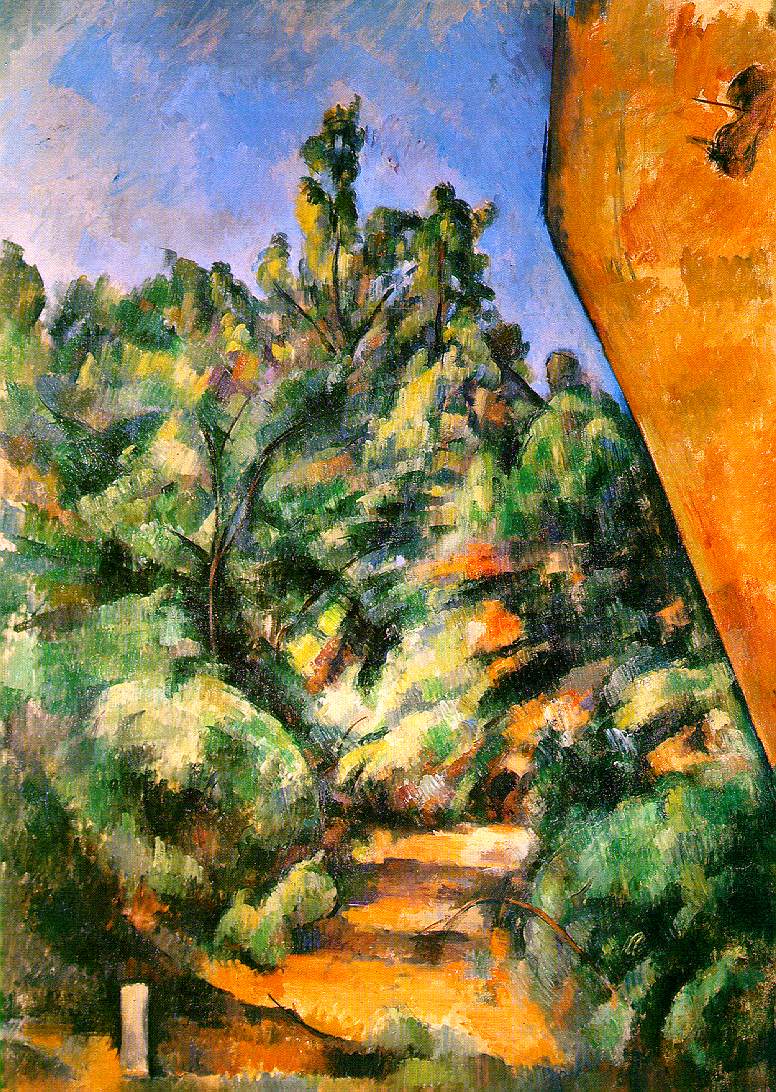 Paul Cezanne. Bibemus: Red Rock. 1895. 91 X 66. Paris
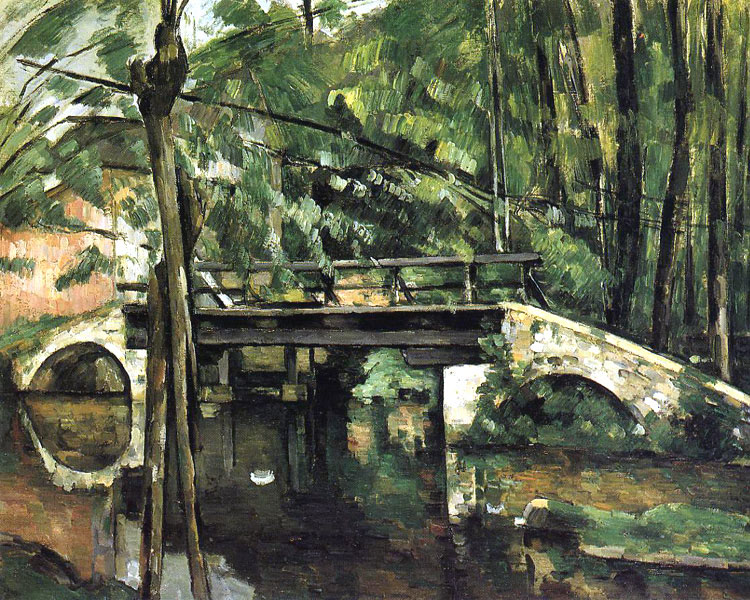 Paul Cezanne. Bridge Maincy. 1879-1880. 58.5 X 72, 5. Paris, Musée d'Orsay
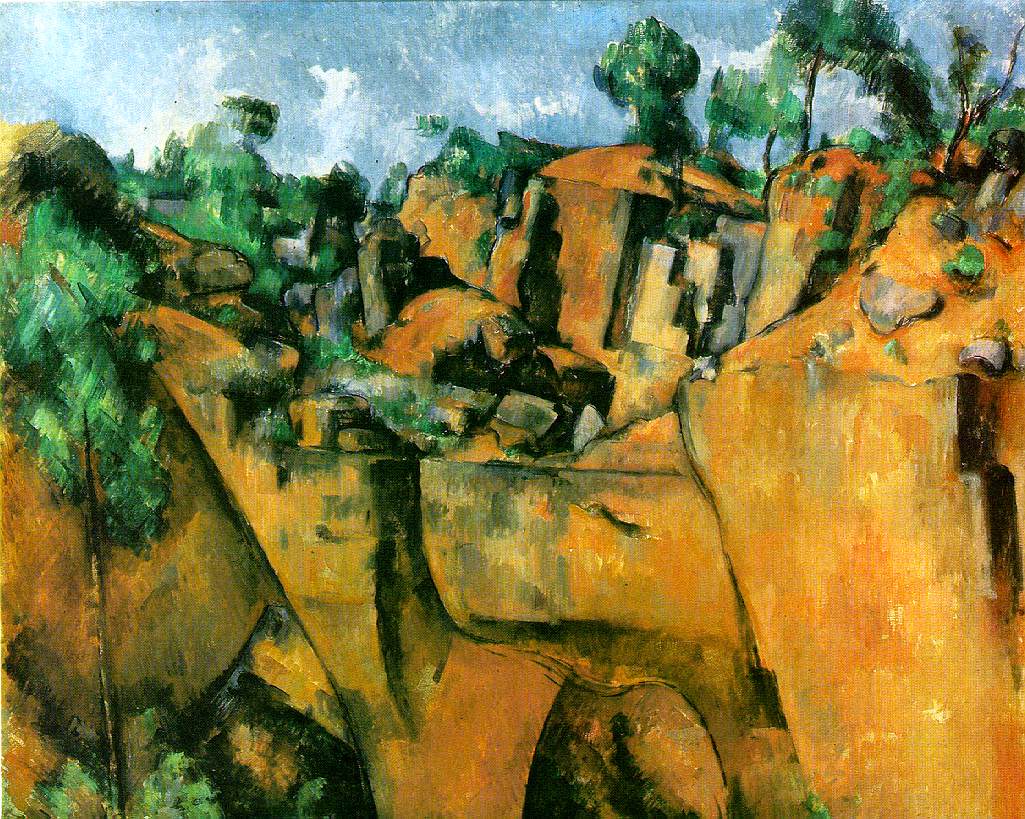 Paul Cezanne. The Career at Bibemus. 1895. 65 X 81. Essen, Museum Folkwang
 Paul Cezanne. Apples and oranges. 1895-1900. 74 X 93. Paris, Musée d'Orsay
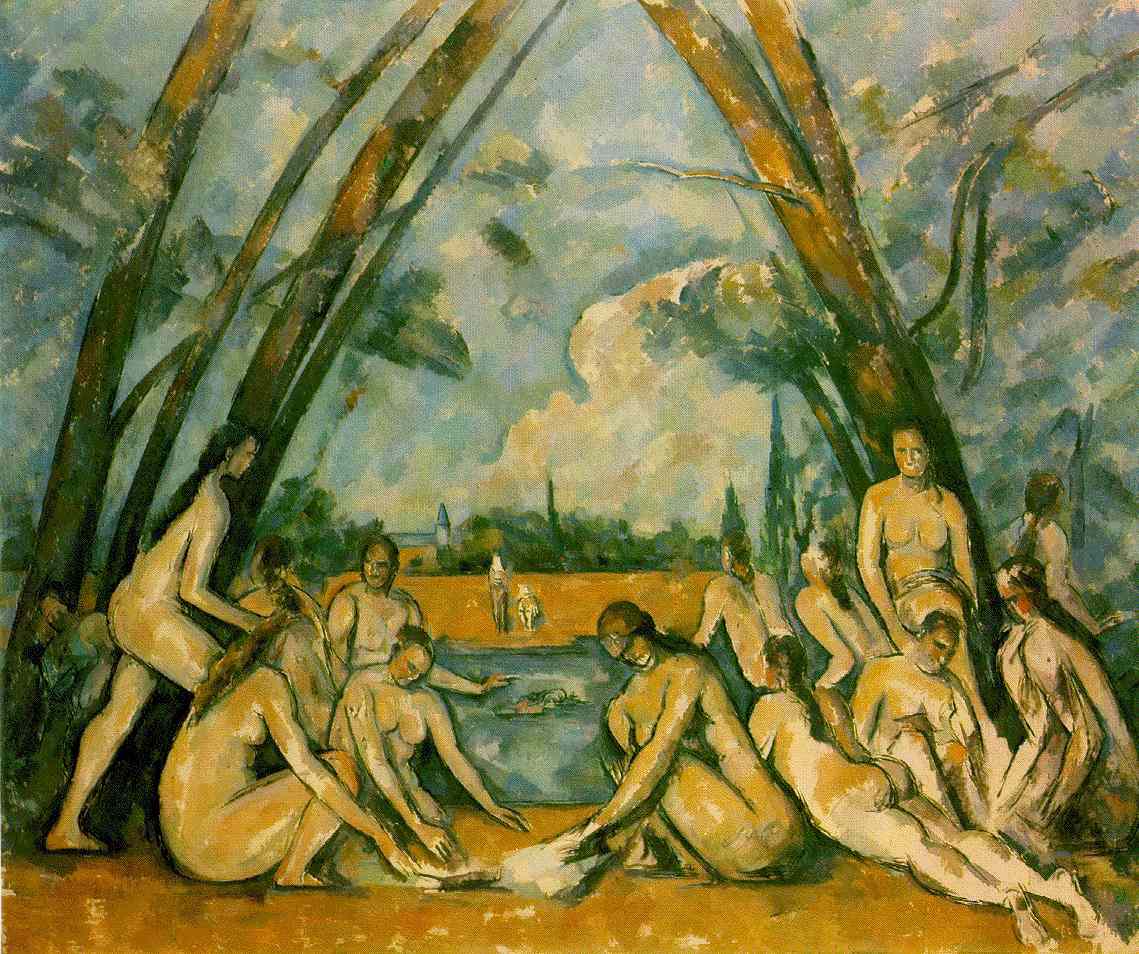 Paul CÉZANNE. Les Grandes Baigneuses. 1898-1905. 208 X 249. Philadelphia Museum of Art


0 comments:
Post a Comment